About Two Owls

Friday, 17 September 2021

August surprise Aquatic Warbler

August I think is always a slightly strange month as summer isn't quite over and autumn hasn't really begun but usually we see the start of the return migration.  This year was no exception with returning Common Sandpiper, Green Sandpiper, Spotted Redshank, Greenshank, Spoonbill and Great White Egret all being seen locally in the first week of the month.  Otherwise it was very much the usual summer species that is until the 17th and typically it was a morning when Jackie and I had decided to have a bit of a lay-in. It was around 06:56hrs and my mobile pinged an alert which is for the local Lytchett What's app group.  It had to be good at that time of morning, so checking it was a message from Shaun who was ringing out in the reedbeds in the bay.  The message 'We have just caught an Aquatic Warbler if you want to see it get to the water works asap'.  We jumped out of bed and fifteen minutes later we were gathered at the waterworks and Shaun arrived and produced a stunning juvenile Aquatic Warbler. What a surprise as the wind was all wrong and conditions wasn't at all right for the species to be in the UK and at Lytchett Bay.

Juv. Aquatic Warbler Lytchett Bay © Nick & Jackie Hull

The next day we decided to have a walk out across the fields and catch-up on some waders that were lacking from our list and as we were leaving Ian messaged to say he had found a Little Stint on the Sherford Pools.  We arrived shortly after and Ian kindly pointed us in the right direction and Little Stint went on the list along with Ringed Plover for the patch.  

Our next real birding trip out was on the 23rd when we popped down to Lodmoor and had a very nice mornings birding.  We didn't get anything much out of the ordinary but had some really nice conversations with a number of different visiting birders enjoying the day.  Highlights of the day were Green and Common Sandpiper, Bearded Tit and no less than three Great White Egrets.

Great White Egret - Lodmoor © Nick Hull

Our next few walks didn't produce anything new until we had a visit to Sunnyside Farm it is here that we often add Whinchat and Yellow Wagtail to our harbour list.  So after visiting Arne to top up on bird food we had a quick stop off at Sunnyside and almost straight away we heard Yellow Wagtails and eventually managed to find them out in the field with the cattle.  

A family walk in Wareham Forest produced very little but we ended the walk with excellent views of Spotted Flycatcher which brought the month's birding to an end.  

Spotted Flycatcher - Coldharbour © Nick Hull

Roll on September what could be waiting for us to see or find.  We are 11 species short of the 200 species with three months still to go it's going to be interesting and close run thing this year.

Wednesday, 8 September 2021

The promised blog at last

 Hi all, sorry this has taken so long we have been a little busy of late with domestic duties etc. but here are a few of the other inverts we saw on our Hartland Moor walk.

Ammophila sabulosa Sand Wasp ©Nick Hull


The Dorset heathland have both species of sand wasp but Ammophila sabulosa is the commonest of the two they are fairly difficult to tell apart but A.sabulosa tend to be larger and have a bluish sheen to the black segment at the end of the abdomen which you can just make out on this shot.  They are a parasitic wasp which predates on moth larvae which it stocks it's burrows before sealing up the burrow. When her  hatch the young then feed on the caterpillars.  The adult will often return and check to see if more food is required at a later date.

Bee Wolf - Philanthus triangulum © Nick Hull


This is another species that burrows into firm sanding soils and it specialises in Honey Bees which it paralyses and stock several cells in her burrow and the covers in the burrow entrance They were formerly rare but in recent years have expanded their range and are becoming quite common around areas that have suitable habitat for them.

Ruby-tailed Wasp - Chrysididae Cuckoo Wasp species ©Nick Hull

We also saw one or two Jewel or Ruby-tailed Wasps the above photograph was of one I found in our conservatory there is quite a large number of species in this group and they need microscoptic examination of the genitalia to get to individual species.  There are others which can be identified from good photographs but still pretty tricky.  

These are parasitic also but they lay their eggs in various other digger wasp species burrows, it often helps to identify the host species burrow which indicates which is the likely ruby-tail species.  For example if the ruby-tailed pictured was Hedychrum niemelia its host would be Cerceris digger wasps.  If it should be Chrysis ignita its host species would be Wood nesting Mason Wasps.

In the last blog I posted a little about the Purbeck Mason Wasp  and during our walk I mentioned that they feed by taking the nectar from the heather flowers but because they have short tongues they short cut by snipping through the side of the flower.  Whilst out surveying after our walk I came across some heather where they had been feeding and took a couple of shots to show what I was describing. 

Snipped out base of heather flowers to enable access to the
nectar by the Purbeck Mason Wasp

To finish today's blog one of the last we came across, digging a burrow then found a few feeding, was a bee with big yellow baskets on the hind legs.  I tentatively identified it as Pantaloop Bee, having not seen a female of the species before, just a male in our garden and that was only for the first time this year.  So I took a few photographs and checked the id at home and indeed they were Dasypoda hirtipes the Pantaloon Bee named for obvious reasons.

Female Pantaloon Bee - Dasypoda  hirtipes © Nick Hull

The next blog will be the August bird and wildlife highlights.

Saturday, 7 August 2021

July Birds and Wildlife

July is always a month that is usually slow for birds though often a rarity will turn up somewhere. Though the best recently have been a five hour drive away with Elegant Tern in Wales and Black-browed Albatross at Bempton RSPB which I have to say is still there as I write and is very tempting.

July is generally a month to catchup on the domestic chores to clear them for the autumn and fitting in a walk or two targeting certain species.  So our first highlight of the month was a evening trip out to Hartland Moor and Arne, where we had superb views of a Hobby hawking over the copse at the Stud farm for around fifteen minutes after which we moved on to Arne for Nightjar.  To save Jackie having to walk far we watched over Hyde's Heath area and saw both male and female Nightjar which performed well for us and I was able to get a few audio recordings of them.

A few weeks ago we had promised friends that as soon as we were back from our Welsh holiday we would arrange to meet them and take them to see Stone Curlew up on Salisbury Plain.   So on the 15th Jackie and I met with them at RSPB Winterbourne Downs reserve. Jackie and I haven't always been lucky here and have to go out on the plain itself to find them or to other locations we know.  So as we walked up the footpath to the screen that overlooks one of the Stone Curlew fields we weren't expecting to see very much.  As we approached the screen I heard a Stone Curlew call and saw a single bird flying across the field and pitching down and called to others and looking through the scope found four birds. Then another two Stone Curlew appeared though they all were on the opposite side of the field to us we could see them well.  Our friends were really pleased as they hadn't seen Stone Curlew for a few years. Little did we know at that point what the future was going to bring.  As we watched them moving around they seemed somewhat restless as all of a sudden they all lifted off calling and circled around and some going one way and some another.  They then settled again in the same area accept one bird which I picked up was flying directly towards us.  I called it to the others and we watched it fly in and pitch down just 20m from where we were behind the screen, only to be joined by two others just afterwards.  They were very alert and nervous and we realised that some people were walking the footpath the other side of the field and must have spooked them.  So we had excellent views very close before they decided it was ok to go back to where they had been a few minutes before. 

Collage of Stone Curlew shots - © Nick Hull

We had a nice picnic lunch and a catch-up with our friends and then left us so could get back for their dog which they left at home but not before adding Red Kite, Sparrowhawk, Kestrel and Buzzard to our day list.  We had decided to Langford Lakes nature reserve near Salisbury to see the 2cy Red-footed Falcon that had been there for a few days, hunting over the meadows.

When Jackie and I arrived at Langford Lakes it appeared fairly quiet so we wondered if the falcon had gone, but as we were there and hadn't visited the reserve for a few years we would take a look around anyway.  We spoke to a birder who was leaving and he said if we hurry the falcon was perched out the front of the hide to the left.  It was a good job Jackie had her scooter as we had to go to the furthest hide but it was worth it as we entered and joined around six other birders the bird was sitting more or less right in front of us on a dead upright wood perch.

2cy Red-footed Falcon - Langford Lakes Wiltshire © Nick Hull

We were very lucky as a minute or two later it took off and started catching dragonflies and eating them and a crow came and landed on the perch and she went off over the meadows behind the hide. Jackie and I decided to leave and we checked out over the meadow and found the Red-footed Falcon sat on an electricity post across the far side of the meadow but very distant. 

July is always a slow month for birding so we tend to go out looking for other local wildlife such as orchids, butterflies, dragonflies, wasp's and bee's. Starting with the botany I had promised Jackie that I would show her Lesser Butterfly Orchid which I was involved with surveying for Back from the Brink project but as 2020 was so restricting for travel we never got to see them.  So things eased this year and so I took Jackie to see these rare orchids and without too much hunting we found 15 spikes but later I heard their were many more which was very good news.

Lesser Butterfly Orchid © Nick Hull

A few days later we had to go to Arne to buy bird food and stopped off en-route and checked if the Marsh Helleborine's were out in flower and found three spikes but later heard there were around 25 a week later so we had obviously saw them right at the beginning. 

Marsh Helleborine © Nick Hull

At the end of the month I had a chance to do a little surveying on the local heaths and caught up with a few of the local specialty inverts like Heath Potter Wasp, Purbeck Mason Wasp also Heath Tiger Beetle and Mottled Bee-fly.

This Heath Potter Wasp is mining clay suitable for making her pot which she will place in the heather or in a gorse bush or sometimes attached to grass. She then catches and encloses a caterpillar into the pot lays an egg and then seals the pot, then starts again with the next.

Heath Potter Wasp © Nick Hull

The Purbeck Mason Wasp has a very localised distribution on our local Purbeck heathlands and is listed as endangered and was one of the Back from the Brink primary species.  They are a stunning wasp that exclusively predates on Acleris hyemana moth caterpillars.  She digs the burrow which will have 1-3 chambers which she will create cells in starting from the bottom. She will provide up to 20 caterpillars and once she has filled the chambers she will seal the burrow with a clay plug to disguise it.

Purbeck Mason Wasp - © Nick Hull

The day I went out with a friend to see this tiger beetle it was perfect conditions hot sunny and little wind, we only walked a couple of hundred metres and recorded 16 of these rare beetles.  They spend much of their life in a burrow in the ground and are only in their adult form for a few weeks a year to find a female and mate, job done.

Heath Tiger Beetle © Nick Hull

Mottle beefly are one of the host species of the Heath Sand Wasp Ammophila pubescens so can often be found in the same locations.
Mottled Bee-fly © Nick Hull

During a reptile survey on the 27th at Arne other than seeing a number of Sand Lizard Stewart managed to find a couple of female Hornet Robberflies a species which has had a 20% decline over recent years. They lay their eggs in manure preferring horse dung but they will use other animal manure if available. They are the largest of the robberflies and are quite a beast at up to 28mm but can be up to 35mm and will take large pry such as grasshoppers.

Hornet Robberfly © Nick Hull

That brings me to the end of July with 183 species to our birding list so far for the year and a nice list of scarce invertebrates coming along.  

For all of you that joined me for the walk on Tuesday I will put together another blog with a bit more about the digger and sand wasps we came across soon, just to help you remember what we saw.

Monday, 12 July 2021

Birding Somerset, North Wales & Dorset

As May ended June started with us birding on Dartmoor at Challacombe Farm we had two visits here one with the grandchildren and another in the afternoon on our own. What was strange for us was the Bluebells as we are used to seeing them in woodland here they covered the moor in profusion which looked wonderful.

one of many fields of Bluebells that covered the moor

Bombus lapidarius - Red-tailed Bumblebee

On our walks here we had our Lesser Redpoll with several flying by but never landing in view. We also had our best views of Redstart with a super male which sang from the top of one of the stone walls to one of the sheep paddocks. 

Singing male Redstart Challacombe Farm ©Nick Hull

Singing male Blackbird Callacombe Farm ©Nick Hull

As our holiday with the Grandchildren came to an end the River Warbler turned up on the Somerset Levels at Ham Wall and the lure of this bird was to much. So on the day we were leaving Dartmoor we had a cream tea at Darts Farm and said goodbye to the family and headed for Ham Wall. 

We arrived to a very packed car park but as Jackie can't walk long distances any more the staff directed us to a disabled parking area near to the first viewing area. This was a great help easily halving the distance required to get to the bird.  So off we went along the path to a gathering of birders all very well distanced and behaved.  We found that the bird had been singing very well but had just disappeared into the reed bed. It didn't take long before it reappeared though briefly.  It then took a while before it returned to it's favoured singing perch and gave us fantastic views and sang its little heart out.  I managed to get a few reasonable photographs and a couple of audio recordings of the bird singing.

River Warbler Ham Wall ©Nick Hull
There must be lots of similar photographs going around of this bird with the amount of photographers that were present.  Though very few people were recording it's song and it came to Jackie and myself that the last time we had seen and heard River Warbler was on our honeymoon 25 years ago in Poland.  We also ticked off a few Great White Egret for the year a species that seems to be doing well on the levels.


We were home around two weeks when we headed off to North Wales to do a little birding and to visit Jackie's aunt.

The 19th was our first days birding where we visited a small reserve at Penmaenmawr which was just up the road from our holiday cottage.  It is a small reserve but in the past has been very good for Redstart and flycatchers.  We started well with a Spotted Flycatcher close to where we had parked and our walk through the woodland only added common species and it appeared that the Pied Flycatcher numbers were down on the normal or they had already fledged as we didn't see one.

Spotted Flycatcher - Penmaenmawr ©Nick Hull

After lunch we headed off to Caerhun this is a small church set above the Conwy esturary surrounded by farm fields here we added a few of the commoner species on the estuary such as Curlew, Oystercatcher and many local gulls. We also added Buzzard and Sparrowhawk and I was lucky to see a Hawfinch fly out of a Yew tree in the church yard but unfortunately Jackie wasn't looking the right way and missed it.

On the 20th we visited Holyhead harbour for Black Guillemot and managed to see at least six in the old part of the harbour.
Black Guillemot - Holyhead Harbour © Nick Hull

After Holyhead we headed to South Stack here we managed a brief flyby view of a Chough and we had our first Puffin of the year plus the usual Guillemot, and Razorbill, Kittiwake and other gull species which have colonies on the stack.

On our return to the holiday home we had time to make a visit to Cemlyn Bay tern colony hoping we would be lucky to see Roseate Tern which had been there for a few days but we had timed it wrong and it had flown out to feed, but we had good views of the common and Sandwich Terns which were continuously coming and going to bring in sand eel and small fish to feed their young.

Sandwich Tern leaving Cemlyn colony to go fishing © Nick Hull


Common Tern in a hover Cemlyn Bay © Nick Hull

The next day we visited Bodnant NT gardens and whilst walking the large park area we came across a male Pied Flycatcher which was a bit of a surprise but a very nice addition to our list. The was also a meadow which was allowed to grow unrestricted and was covered in wild native flowers and many Common Spotted Orchids.

Orchid Meadow Bodnant © Nick Hull
On the 22nd we headed off to World's End a grouse moor in the Snowdonia National Park, it's an area we have visited a few time over the years to see Black Grouse but unfortunately this time we failed to see any. Though Jackie did find a couple of Red Grouse and we had several Whinchat and the highlight was a male Merlin that put in an appearance.

The approach up onto World's End with a few local sheep © Nick Hull

Male Whinchat -World's End © Nick Hull

Before we left Wales we visited the Great Orme here we managed to see more Chough but I managed to get a few shots of the now famous Kashmir Goats that live feral on the Orme and at night come down to the town and munch on the flowers and hedges of Llandudno.

Kashmir Goats - Great Orme © Nick Hull

Whilst we were on our last couple of days in Wales news broke that a Melodious Warbler had been found and was singing regularly in and around Tom's Thump a small pine copse at Middlebere. So after arriving home on the Friday we chanced it would stay until the next day and visited Saturday morning. We were not disappointed because as we arrived and joined a couple of local birders that was already watching and listening to the bird we could hear it singing.  It took us a minute or two to locate it with some directions from Gary and Martin and then it was just a case of enjoy the moment.  I managed to get a couple of reasonable shots and an audio recording which brought June to a very nice end with 121 species for the month.

Melodious Warbler - Middlebere © Nick Hull

Wednesday, 16 June 2021

May Highlights

 Well, May was a busy month one way and another and there were a few domestic duties which kept us away from birding and we only managed eight days where we ventured out and about.  This was trying mainly to see birds for our year list and it wasn't until the end of the month we realised that we were short of 100 species but we had seen some quality so there was no complaints.

The first eight days of May were pretty awful the only year tick came with a Cuckoo at Garston Wood and it wasn't until the 9th that we twitched to Longham Lakes to see a Whiskered Tern.  There has been eight records of this species dating back to 1836 with one at Lyme Regis which was shot in late August the next was from Christchurch in June 1875. More recently Stanpit Marsh 1967, Lodmoor 1987, Stanpit Marsh 1987 and again here in 1988, Radipole Lake in 2008, then Swineham GP in 2011 which brings us up to the Longham in 2021 being Dorset's ninth, so a good county year tick.

We had visited Garston Wood in the morning with my daughter and granddaughter and had a good time looking at the orchids, bluebells and wild garlic amongst all the other early woodland plants and it was as we were leaving that the Whiskered Tern came on the info services so we took them on their first twitch. We arrive and walked towards the South Lake and stopped at the corner and had a quick scan the tern was flying around the centre of the lake and there were a handful of other local birders watching it.  

Whiskered Tern © Olly Frampton

We found a convenient place to watch and had good passing view and then it pitched up on one of the lakes depth posts and thanks to Olly Frampton for allowing me to use his shot above of this moulting adult. I have to say our granddaughter really enjoyed seeing it which topped the day.

On the 23rd we met up with friends to have a walk around Lodmoor RSPB and we picked a good day as we had good views of Bearded Tits and then on the West Scrape Jackie picked out a 2cy Bonaparte's Gull that had been around for a few days. There has been nine county records the first back in 1970 and the most recent at Longham Lakes in 2018. 

2cy Bonaparte's Gull Lodmoor RSPB © Nick Hull

We also had good views of a Spoonbill which had arrived in the early morning and it gave a good view as if flew by us as it moved out on the marsh.

Spoonbill - Lodmoor RSPB © NIck Hull

We had very little opportunity to get out again until the 27th when we had a evening drive around the northern chalk area of the Cranborne Chase where we added Barn Owl to our year list always a nice bird to add.  

The end of the month saw us travel out of Dorset down to Devon on a weeks holiday with daughter and her husband and our two grandchildren which should of happened in 2020.  Here on various days out we added Pied Flycatcher at Yarner Wood and Cirl Bunting at Labrador Bay RSPB which ended our month on 91 species just under our 100 target but with some absolute quality birds seen.

Male Pied Flycatcher - Yarner Wood Devon © Nick Hull


Monday, 10 May 2021

April 2021 "Month of Surprises"


Well April started a little windy but continued dry with generally warm days and cold nights with an occasional frosty morning with the wind coming in from the North-Northeast which isn't the best for migration and it was slow going around the harbour but we met our challenge and recorded 105 species for April with a few highlight.

Our first noteable species was on the 6th April when Jackie and I met four friends for a walk around Stanpit Marsh at Christchurch to see if we could find the long staying Glossy Ibis which we failed to find. Nonetheless we had a good morning and it's always nice to catchup with friends now after the lockdown easing.

I took a more scenic route home which took us via Cranborne where we came across a Red Kite as we exited the village, a very nice year tick being we had missed a couple of sightings over the bay at home.
Red Kite © Nick Hull
Our next visit was to Portland Bill on the 11th we hoped we might find the Ring Ouzels at Barleycrate's but had no luck, but the visit wasn't a waste of time because we were short of a few coastal birds and added Guillemot, Razorbill, Gannet and Shag to the year list and it made a nice change to see some different scenery.

We visited Swineham on the 13th this was a warbler hunt and we started as we left home with a Lytchett Bay Willow Warbler and managed to see our first Reed Warbler and only heard Sedge Warbler at Swineham. Two days later we were up early to carry out the second visit of our Woodlark survey. This proved to be a couple or so hours walking an area of heathland and seeing everything other than Woodlark.  We even had views of an Osprey and heard Lesser Spotted Woodpecker which was totally unexpected surprise.

Longham Lakes is always worth a visit particularly when a Garganey has turned up so on the 20th Jackie and I drove to Longham with the hope of catching up with a drake that had turned up a couple of days previous.  Though we walked around the whole of the South lake we never found the Garganey.  But whilst walking along the bottom end of the lake I picked up a Sand Martin crossing the path in front of us and called it to Jackie who looked up and said "What are those bird up there they look like Storks" I looked saw a few gulls then higher and Jackie repeated "they're definitely White Storks", indeed there were five White Storks in a thermal and they slowly moved over us towards the West and later were see still moving west near Dorchester and the next day were on fields near Exmouth in Devon.
Unfortunately by the time I thought about taking a photograph of the birds they were to far away so the shot below is of some I took in Spain on migration a few years ago.

White Stork - Spain © Nick Hull

We also saw our first Common Whitethroat of the year here so not a bad morning after all, but the month wasn't over yet though we had to wait a few more days.

We had a trip out of county on the 27th meeting friends and doing a little birding at Blashford Lakes our old local patch.  I took my recording equipment as I hoped that there would be Garden Warblers on territory or at least singing well as Blashford is a great place for this species.  In fact it is good for Blackcap as well so a good site to go and get your ear into listening for the two species. I managed to get a nice recording and I had a catch-up on Jackie with seeing and hearing Firecrest in the holly along one of the paths. All in all it was another successful trip but we were getting close to the end of the month and wanted to do better that March with our final count and only a few days to go.  So next day we went for a walk at Middlebere which turned out to be very quiet but we added two Lesser Whitethroat to our list.

As we were walking back to the van we had news that a drake Garganey had been found and in of all places Poole Park on the small lake in front of the restaurant, so off we went and it turned out to be a very easy twitch.  We just parked the van hopped out found it took a few shots back in the van and home for lunch perfect.

Drake Gargarney - Poole Park © Nick Hull

The next day and a half was a period of catching up with things at home mainly jobs around the garden but we had reports of a couple of Nightingale that had been heard singing in the harbour area.  So we thought we would try some after dinner birding with the recording equipment and see if we could hear at least one of them.  We did locate one and I managed to get a little recording of it singing unfortunately there is a little vehicle noise in the background but hopefully that will not distract too much.

Saturday, 10 April 2021

A Good Month on the Patch and a Twitch to Weymonth

 Like always you have some luck and some bad luck and this month has been "Swings and Roundabouts", with much of the usual Lytchett Bay species being seen at the start of the month.  We started on the 3rd March out on Higher Hydes Heath at Arne as I was helping RSPB in my volunteer role surveying for reptiles.  At it's early in the month and we didn't expect anything really but it's an opportunity to lift the Artificial Refuges (AR's) and make them more attractive to the reptiles.  Whilst Stewart and I did this Jackie surveyed the birds. The most notable were the number of Crossbill that we saw plus Jackie and Stewart  located a probable nesting site.

Our next birding walk was on the 8th when Jackie and I were walking along towards Turlin Moor and had a very noisy Bearded Tit calling from the reed bed though it refused to show itself.  Otherwise the walk was rather mundane. Next day or rather in the late evening I went into the office to close down my computer and as I was sat at my desk I heard a Coot calling and I rushed to the front door and outside as quickly as I could and heard it call several more times as it headed west towards the fields.  You may think rushing out to hear a coot is odd but they are extremely rare to see in the Lytchett Bay recording area and usually only recorded on Nocturnal Migration (Nocmig) when they fly past my microphone at night. The nocmig recording list I keep separate from the day to day birds we see or hear on the patch hence my rush to the front door to get it on the patch list.  I've had several more over the month migrating past my listening station along with Mediterranean Gull, Little Grebe, Water Rail, Moorhen and Curlew plus a few nights of Redwing and Song Thrush moving back to their breeding grounds in Europe. 

The next highlight of the month was on the 16th when Liz Woodford telephone to say she had a White-tailed Eagle flying towards her over the Lytchett Bay view point. Jackie and I quickly rushed out and down the road the couple of hundred metres and Liz was pointing up above us and yes there it was probably 213m (700ft) above us was an obvious large eagle gliding north.  I took an handful of record shots but didn't expect anything to be good as it was so high.

White-tailed Eagle going north over Lytchett Bay View © Nick Hull

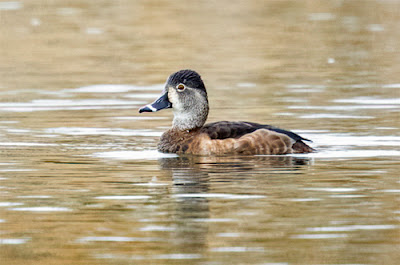
Our next excursion (18th) was to Longham Lakes to see if we could find the Ring-necked Duck and in fact it turned out to be quite easy as we found it on the north lake loosely associating with a few Tufted Duck.  We had good views though it was very active driving regularly but would occasionally rest and preen on the surface between dives.

Female Ring-necked Duck_Longham Lakes © Nick Hull

Two days later we went to Garston Wood for a walk and to see if the wild garlic and bluebells were starting to flower but we were a little early.  We did manage to see 29 Corn Bunting on route and record Marsh Tit singing in the wood so not a bad mornings trip out.

Our next was a short drive around Hartland Moor to see if we could find Wheatear on the fields by the Horse Stud which we managed to do find two very smart individuals.  We met a friend here who asked if we had seen the Little Ringed Plover at Holme gravel pits and we said no we hadn't and he kindly described roughly where to look for them.  So about 15 minutes later we were scanning the bank on the gravel pit and managed to find one of the Little Ringed Plover in almost the place we were told to look.  We also added a good number of Sand Martin and a couple of Swallow to our list here making it a really good stop.

The next day the lockdown eased and that morning a Desert Wheatear was found by Dave Chown behind the the Park & Ride (Covid test centre) at Weymouth so we headed off there after lunch and once we found where it was we didn't take long to locate it and have some very good views.  What was particularly nice  this bird was a first summer female and previous birds we had seen had been males but this was the first we had seen in Dorset which was even better.  We ended the day having fish and chips at the top of Came Down and ticked off Yellowhammer before driving home.

1st/summer female Desert Wheatear - nr. Lodmoor ©

The last day of the month gave us a Lytchett Bay year tick when Shaun telephoned to say he was listening to a Lesser Spotted Woodpecker drumming in the trees by the allotments entrance on Slough Lane. We grabbed our bins and I grabbed my recording kit to and headed off up the road. We both started to hear the bird drumming as we were walking down the lane and I managed to make a reasonable recording of what appeared to be a pair duetting.


The Lesser Spotted Woodpecker brought out month list to 101species for March.  We were lucky as they've not been seen or heard since unfortunately.