Tuesday, 12 January 2021
December Update & Lockdown 100 - 2021
Thursday, 10 December 2020
November Birding
Well we managed to keep to our challenge of reaching a 100 species which we just managed to top this month but there were still species that we missed so the possibility of doing the same in December I believe is still on.
With going into a second lockdown we were very aware of keeping local so the month's birding started for us on the 2nd with a short drive to Longham Lakes before lockdown started. It was a real grey day with the possibility of a shower but the birds we wanted to catch up with were all around the north end of the South Lake. Arriving mid morning there were a few people walking around the lakes and most were birders. Our first birds were the local species Coot, Mallard and the usual gulls then we picked up our first Great White Egret. Our next target was the Green-winged Teal and we found that on the north end of the north island sat in amongst a few Common Teal and one or two Little Egret and Mallard.. Unfortunately it was a tad too far to get a really good shot of it.
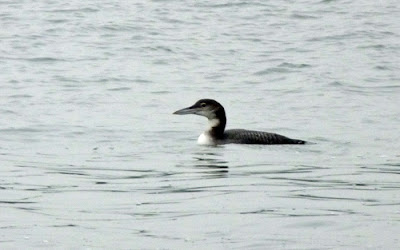
It was about this time a Dorset birder that we hadn't met for quite some time Bagsy aka Paul Baker, a real character that now lives nearby, came along and we were able to have a bit of a catchup and was able to point him in the right direction for the Green-winged Teal. We walked on across the causeway finding another Great White stood out in the field west of the lakes. We then met George Green and asked him if he had seen the Great Northern Diver and he told us that it's been around the corner of the lake where we were. Scanning we eventually picked it up as it surfaced and whilst we watched it came real close to our bank and gave excellent views. There was just one other target species that we hadn't seen and we were told it had been on the small island in the south of the lake but we couldn't find it there. The sky had darkened and a few spots of rain were felt and I hadn't a waterproof so we decided to start walking back to the car. As we approached where we had seen the Green-winged Teal we thought we'd take another look and there stood almost next to it was a Cattle Egret, where it came from and how it passed us to get there know one knows, but none-the-less a good way to finish a morning's birding and just as the rain was starting.
![]() |
| Green-winged Teal © Nick Hull |
![]() |
| Great Northern Diver © Nick Hull |
![]() |
| Cattle Egret © Nick Hull |
What a great start to the month's birding but we knew it would be harder to get to the hundred once the lockdown started so next day we went off to Studland and started at Jerry's point in the hope that the Long-tailed Duck was still in the area. We spent some time scanning the harbour from the shores of Brownsea Island across to Furzey and Green Islands and into Brand's Bay. We managed to find Common Scoter and Scaup, we picked up our first Goldeneye but the water was very choppy and birds were hard to find and see on the water. Before we left we added Red-breasted Merganser to our list which were in a raft in the shelter of Furzey Island there was also a diving duck with them with a low profile possible a Long-tailed Duck but we couldn't quite clinch it. We moved on to Middle Beach and checked out over the Poole Bay and only added Black-necked Grebe. A slow drive through the village didn't produce the Ring-necked Parakeets but we couldn't spend much time here as we were expecting a delivery at home so we called it a day. Though not quite as we took a short detour on the way home cutting across Hartland Moor in case we could add Hen Harrier or Merlin which we didn't but did see Fielfare and Redwing which was a bonus.
Over the rest of the month which was spent around various location of the harbour we continued to added many of the usual species of wader and woodland birds. Highlights were a local surprise whilst at Lytchett View on the 4th with a single Egyptian Goose which flew into the bay. Two days later we visited Arne and added Spoonbill to the list with 31 roosting on Shipstal Point. The 19th was a wet and stormy day so we popped around the harbour from Sandbanks ferry back to home the only highlight was single Sandwich Tern on Baiter. Our next was whilst taking a drive around across Hartland and we had a Merlin cross the road at Slepe Copse on the 21st.
Next morning Ian found a Goosander out in Lytchett Bay and as they are scarce on the patch Jackie and I had a walk to the viewing area at the end of footpath 12. It took a while but we eventually spotted it out in the main channel in the west of the bay. We had to wait till the 24th to get Marsh Harrier on our Lytchett list when we had an adult female being harried by a couple of Carrion Crow over the Holton side of the bay. We were now at 99 species and very close to the end of the month we decided to have a drive out to the Cranborne Chase to see if we could add one or two more species to the month's list and indeed we did with Corn Bunting and Red Kite and Yellowhammer. We finished the day in the Lower Avon Valley where we had 5 Ruddy Shelduck with a large mixed flock of Canada, Greylag and Egyptian Geese in a field between Sopley and Bransgore.
Though it was nice to see the Ruddy Shelduck as they were the 104th species for the month they aren't on the British list as they are considered a feral species from the European feral population and not true wild birds. I think many birders think perhaps they should be on category C of the British list and countable as the European feral population are increasing and sustainable which is the most likely origin of these super looking ducks. Also they turned out to be just inside Hampshire. So our month ended on a 103 species.
![]() |
| Egyptian Goose & Ruddy Shelduck near Sopley. |
What will December bring as we can travel a little further round the county hopefully picking up a few more species who knows...
Sunday, 8 November 2020
End of the October Post
Jackie and I started October with a quick visit to a field at Anderson, just past Red Post off the Bere Regis road, where a White Stork had been seen a day or two earlier. No colour rings had been noticed so if it was an un-ringed bird it may have been a truly wild bird. I managed to park off the road safely and we scoped the bird which was walking around out in the open and appeared to be eating grasshopper species. A quick look at the legs and there was a white colour ring and it was found to be one of the Knepp Stork Project birds exploring no doubt. None-the-less it was still a nice bird to see also whilst we were there we had around 200 Linnet in a flock feeding in the weedy field. Though as it's a introduced bird it can't be checked off on our year list as its not a truly wild bird but it was still very nice to see.
Jackie and I visited fourteen locations around the Poole Harbour over October and recorded 114 species this is isn't a complete list as many other species were seen by others observers so the potential to seen more was available but they were missed by us. Saying this we had some good sightings we managed to see the Long-billed Dowitcher again before it left, and the two Curlew Sandpiper were still visiting Lytchett Fields. Other highlight for the month were Grey Phalarope (10th), Yellow-browed Warbler and Firecrest (11th), 2 Glossy Ibis (20th), Hen Harrier (22nd) and 27 Spoonbill (29th), we also recorded our first sightings of Redwing and Fieldfare for the autumn.
Jackie and I tried three times for the Grey Phalarope and failed to get this bird, then a text from Ian to say it had returned to the fields and we were lucky enough to get to see it. A really smart little wader and a great addition to our Lytchett patch list and our second in a month.
![]() |
| Grey Phalarope - Lytchett Fields © Ian Ballam |
The Yellow-browed Warbler was a really nice year tick and very typically Jackie and I had a lay-in and the mobile goes off just as I'm about to go to the bathroom and it's Shaun Robson. "We are ringing at Lytchett Heath and just caught a Yellow-browed Warbler if you can get here quick we will keep it a few minutes". So it didn't take long for us to be in the car and up the road and join the ringers and see this little gem of a bird in the hand.
![]() |
| Yellow-browed Warbler, Lytchett Bay Heath © Nick Hull |
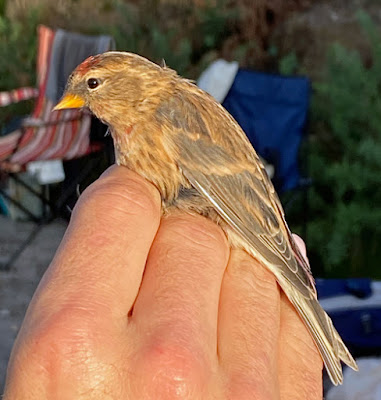
Whilst we were there they carried out another net round and we were lucky enough to see two or three Lesser Redpoll up close as well.
![]() |
| Lesser Redpoll, Lytchett Bay Heath © Nick Hull |
The two Glossy Ibis was a bit of luck and a surprise in some ways. We had arranged a social distanced walk at Studland meeting four friends to do a little birding around the village. The area is good in October to pick up Firecrest and migrant warblers plus the added benefit of grebe, divers and sea duck out in the bay.
We were scanning the bay where we picked up a few scattered Great Crested Grebe a small group of Common Scoter and a couple Black-necked Grebe. Viewing further out towards the Cruise Liners I picked up a immature Gannet heading towards Old Harry Rocks and got everyone onto it. I then started scanning again, when Liz said what's this over Old Harry now, I quickly got onto the bird and noticed a dark blackish looking bird with legs out the rear and a long neck and a downward curving bill a Glossy Ibis. It circled to gain height and slowly moved across the bay over the liners and headed toward Hengistbury Head. I Tweeted the sighting out and added Olly Frampton who about ten minutes later messaged me back to say there were three Glossy Ibis at Stanpit Marsh which had just been joined by a fourth presumable our bird, which was nice to know. Well we continued our walk around Fort Henry I was scanning the tree tops for the Ring-necked Parakeets when to my surprise another Glossy Ibis flew between us and The Pig on the Beach Hotel heading south towards Glebelands. Unfortunately we lost sight of it so we're not sure if it cleared Ballard Down ridge and headed over towards Swanage or turned and headed west inland.
We then carried on our walk up to Studland Church and back and as we came to the viewpoint to look over South beach again something disturbed the birds below on the rocky shoreline and there in front of us appears a Great White Egret, which flew off over the wood out of sight which ended our day very nicely indeed.
We caught up on Hen Harrier over Hartland Moor where we also ticked off a flock of Fieldfare with a handful of Redwing in tow and we ended the months birding on the 29th with a visit to Arne where we added 27 Spoonbill to our monthly list.
We are now wondering what will Lockdown 2 bring us now we are into November birding.
Monday, 5 October 2020
Monthly Listing plus VisMig and NocMig & Moths Catchup
Sunday, 9 August 2020
Catching up with Scarce and Rare Inverts
![]() |
Southern Migrant Hawker - Lytchett Bay © Nick Hull |
![]() |
| This is the view I had of the Nightjar nest & eggs taken with a long lens © Nick Hull |
![]() |
| This is the same photo just heavily cropped © Nick Hull |
![]() |
| Pondweed Leafhopper Erotettix (=Macrosteles) cyane © Nick Hull |
![]() |
| Large Marsh Grasshopper Stethophyma grossum © Nick Hull |
![]() |
| Bog Bush Cricket Metrioptera brachyptera © Nick Hull |
![]() |
| Marsh Gentian © Nick Hull |
![]() |
| Heath-Grasshopper Chorthippus vagans © Nick Hull |
![]() |
| Heath-Grasshopper Chorthippus vagans © Nick Hull |
Wednesday, 22 July 2020
Getting Back Into The Groove
We then moved on to Haxton Down area of the plain where we stopped at one of the many tank crossings to have our lunch. This turned out to be a fantastic choice of stops, as we had ate picnic we were able to listen to Whitethroat, Corn Bunting, Linnet, Stonechat, Skylark and Blackbird all singing around us. It wasn't until we had just about finished our lunch both Jackie and I said 'Quail' at the same time and one was calling somewhere very close to the rear of the car. Jackie and I got out of the car and walked slowing towards the 'wet-my-lips' calls and scanned the grassland which wasn't terribly dense but it was obviously thick enough because neither Jackie or I managed to get eyes on either of the two Quail that were singing though they appeared to be very close at times. I managed to get a little recording of them calling which they were doing quite incessantly whilst we were there.
| Mottled Bee-fly |
We were expecting a delivery in the morning so I did some reading up on the species and how to identify it from the Manx and Balearic that would be present during the morning. Shuan a friend had gone in the morning and mentioned it in a text that it was still present and well worth seeing. So Jackie and I had lunch and left for Portland arriving around 16:00hrs. There was around a dozen other birders present but easy to distance and we picked a spot that gave us the best view over the feeding and resting Shearwaters Gannets and local Herring Gulls that was sitting on the water about a hundred meters off the Bill. We had been searching through the melee of sea birds without picking it up for sometime, in fact I was beginning to think it had gone. When I saw a small shearwater flying left, right of the obelisk which it disappeared behind. It seemed an age before it reappeared more or less in front of us but about 100m out, it banked right and I had a good underside view and I saw the dark bar on the underwing which confirmed I had the Yelkouan.
![]() |
| Yelkouan Shearwater - Portland Bill internet photo photographer not named. |
Of ten previous British records nine are listed as unproven until one was accepted in 2008 seen from Berry Head. So if this Portland bird is accepted it will be the second British record and a first for Dorset, a good bird to see.
Sunday, 31 May 2020
Semi Lockdown, Whatever That Means Post?
Later we went out to our local heathland for Nightjar which was very successful and I managed to get a couple of reasonable recordings of churring bird and the kwick calls unfortunately not the wing clapping something for another time.
![]() |
| This sonogram of the Nightjar churring shows how rapid it is and how consistent it is in pitch. |
![]() |
| Sonogram of Marsh Warbler song |