About Two Owls

Monday, 22 March 2021

Catching up on the Birds

Well since October when we challenged ourselves to see if we could see a hundred species a month throughout the winter I have to say all was going well until we arrived at February in lockdown.  We gave it a try but it was a short month and we failed right at the end of winter with 89 species for the month this was mainly due of course on the lockdown restriction on travel but nonetheless it wasn't bad.

We had a few highlights recording our first Ringed Plover, Golden Plover, Little Gull, Peregrine also a Ruddy Shelduck. More controversial is the sighting of two gulls on the Brownsea Island Webcam, that of a immature Glaucous Gull and the harbour's first Caspian Gull, were they tickable as no one was permitted to go to Brownsea and see them, but we were watching live on the webcam only a mile or two away from the birds. The question was raised if you were watching your own webcam and a rarity popped in onto your feeder would you count it on your garden list and almost everyone said yes they would.  So what is the difference in watching someone else's webcam and ticking off the bird, of course we can't but it was a fun discussion via an internet pub meeting.

Glaucous Gull screen grab off the Brownsea webcam

Caspian Gull screen grab off the Brownsea webcam

I apologise for the quality of the photograph of this immature Caspain Gull, I don't think you can improve much from a screen grab, but full marks has to go to Paul Morton who picked it up when moving the camera searching for the arrival of the Glaucous Gull into the lagoon.

The best of our birding highlights that was a true tick was the Little Gull on the flooded fields at Swineham. They are Jackie and my favourite gull species and we had good views of it hawking across the Piddle River and the flooded meadows in very good light.  Peter Moore was there and he is a excellent photographer and he has kindly allowed me to use a couple of his photographs of the bird here.

cLittle Gull - River Piddle Water Meadows Swineham © Peter Moore

Little Gull - River Piddle Water Meadows Swineham © Peter Moore

The Golden Plover were found by a friend on the field opposite Holton Heath trading estate so Jackie and I took a quick drive the couple of mile up the road and picked them up very easily. They are quite a scarce species in the Poole Harbour basin these days so a very nice sight even if it was only around twenty birds. The Peregrine was seen when we had to pop out to the pharmacy at Asda and picked up the regular birds that sit around on the flats there.  The Ruddy Shelduck was when the van needed a drive to charge up the battery as it hadn't moved a wheel for a few weeks so we decided to do a little circuit.  While out a friend had noticed that there was a Ruddy Shelduck on a local gravel pit and we just happened to be passing so stopped and had a brief look and found it very easily which was a nice end to our little excursion. 

March has started well we have almost equalled February recording 83 species so far and with the slight change in the lockdown rules hopefully we will be able a little more freedom to travel around a bit more locally which should add a few more species plus migration has already started with the first Chiffchaff, Swallow and Sand Martins being seen.  We only had Chiffchaff so far but the overall highlight was seeing a White-tailed Eagle over Lytchett Bay found by Liz Woodford.  Here is another poor photograph this time taken by me as the bird was gliding off to the north.

White-tailed Eagle_Lytchett Bay © Nick Hull

Well the month isn't over yet and lockdown rules are changing so I'll stop here with a total of 120 species for the year so far. At this time in 2020 I was on 155 species so have a little bit to catchup so I'll leave it there and do another blog at the end of the month.

Friday, 19 February 2021

Hedgehogs Upton and Lytchett Minster


For a change instead of telling you about what Jackie and I have been up to which hasn't been much because of lockdown. I thought I'd add an article from the Upton & Lytchett Minster Hedgehog group it's more or less a summary of what has been happening and what's being done to help the hogs of our town.  They are doing great work and need all the support to continue the work they have started so if you would like to help there is a link to their Just giving page at the bottom of the article.

Hedgehogs in Upton and Lytchett Minster.

We started volunteering for the Dorset Mammal Group as hedgehog coordinators in summer 2019 as part a project called Hedgehog Friendly Towns.  The Dorset Mammal Group's main focus is to reverse the decline in hedgehog numbers and this project is just one of the ways in which they wish to achieve this. Sadly hedgehogs are now vulnerable to extinction in the UK and we need to do all we can to save them. 

The Dorset Hedgehog Friendly Towns project now has 33 towns signed up and 4 more have shown an interest. 

The main goals we want to achieve in Upton and Lytchett Minster are:

·       Encouraging people to create hedgehog friendly gardens and cut hedgehog highway holes in their fencing.

·       Educating residents on what food is safe to feed to hogs (not mealworms, peanuts or sunflower hearts!).

·       Explaining about the dangers of slug pellets, steep sided ponds, garden strimmers and rat poison.

·       Work with the allotment association to promote organic growing and creating habitats on the site. 

·       Reducing hedgehog road casualties.

·       To work with local schools and engage with young people.

·       Fundraising for the Dorset Hedgehog Hospital

We quickly realised how popular hedgehogs were in our town, when over 80 people turned up to the first meeting! The second meeting was just as popular and we can't wait to have another one when guidance allows us. 

We have had an amazing 170 hedgehog sightings from residents during 2020, mostly from their gardens. Most of these are from Upton, and the majority are located around Moorland Way and Sandy Lane. We would like to get more residents on board this year to see if there are more hedgehogs across the whole town, or perhaps the hedgehogs are concentrated in that area. We are particularly keen to hear from people in Lytchett Minster, because we haven't had much data from there yet.  

The project is very new and we only have 1 full year of hedgehog sightings, however it appears there is a good population within our town and they are certainly breeding within our gardens and having multiple broods. Our winters are very mild in Dorset and we know that not all hedgehogs will hibernate. We are encouraging people to continue to feed during the winter, because this helps the late broods to fatten up and keep going through the colder months, when there is less natural food around. 

Sightings of Hedgehogs in the town

There are over 100 residents registered to the project already, who have created a hedgehog friendly garden and want to help them. We hope to get more people onboard this coming year. 

 There were 43 hedgehog road casualties reported to us during 2020, we noticed a significant increase, when the initial lockdown was eased. This has given us the data to find the black spot locations, where we would like to install road signs to encourage motorists to slow down. We are hoping to have the signs installed this spring before they awake from hibernation. 

Map showing Hedgehog road casualty locations

As a temporary measure we installed "ghost" hedgehog signs in prominent locations across the town to show people the amount of hedgehog road casualties. This was done across Dorset and promoted by Hugh Warwick hedgehog extraordinaire. 

The following are the worst roads, which happen to be the main roads through the Town. 

·       Sandy Lane

     Moorland Way

·       Blandford Rd North

·       Blandford Rd 

·       Dorchester Road

We have been working closely with Tracy and Jim at Hamworthy Hedgehog Rescue who do an amazing job dedicating all of their time to rescuing hedgehogs. Last year they rescued 698 and released an amazing 523 back to the wild. They still currently have 148 in the care! They explained to us recently that they get most of their intakes from Upton. Without the kind work they are doing, we wouldn't be able to help as many hedgehogs as we have.  

Sadly it would appear there is a growing trend to paint hedgehogs! We are hoping this is due to residents who wish to identify their hedgehogs. However using emulsion paint on a wild animal is cruel and can make them stand out to foxes and other predators. Tracy has had many entries into their rescue which are covered in multiple colours of paint. We have also both had painted hedgehogs within our own gardens. There is no reason to paint or mark a wild animal, we should just enjoy watching them from a safe distance and learning the individuals by their behaviour and subtle differences. 

One of the Dorset Mammal Group's other projects is to fundraise to create a hedgehog hospital in Dorset. This will help hedgehog rescuers and carers across the county, by offering veterinary care 24/7. https://www.justgiving.com/crowdfunding/dmghedgehoghospital

Tuesday, 12 January 2021

December Update & Lockdown 100 - 2021

Well Jackie and I managed to get 104 species by the end of the month keeping up are challenge, though it was a little more difficult as we had Christmas to contend with.

Our highlight for the month wasn't anything really rare but still very nice to see Cattle Egret on our home patch first noticed by Shaun flying to roost in Holes Bay, they would fly over Lytchett Bay in the last hour of daylight with accompanying Little Egret.  It was at the end of the month when we had to put a little extra effort in to get to the 100 when we had a surprise male Hen Harrier on the 26th near Bere Regis; Short-eared and Barn Owl on the 27th in the Cranborne Chase; male Merlin at Arne on the 30th and our last species of the year was Bearded Tit on the evening of the 31st, not a bad species to end with at all.

Male Bearded Tit

New Years Eve began with firework everywhere and next morning we walked out to the bay to start our 2021 list and it was hard to find any wildfowl at all. All obviously vacated the bay to go to a quieter part of the harbour once the screeching and bangs started. We gave it a couple of hours and then walked back home for a hot drink and a warm up and then we headed off to see if we could add a few more species to our year list.  

We checked out a few game crops that we had been told about which attracted Linnet, Yellowhammer, Reed Bunting, Chaffinch and Brambling.  The first location produced lots of Linnet and Chaffinch but we also added Nuthatch, Treecreeper and Marsh Tit the latter was a real surprise.  Our next location was two fields that had sunflowers that had not been harvested and a large number of finches, Reed Bunting were amazing with Yellowhammer in smaller numbers I managed to see one maybe two Brambling but unfortunately Jackie couldn't get on to them quick enough before they disappeared into the sunflower crop.  Though Jackie did pick out a Merlin which zoomed off south carrying prey. We spent possibly two hours trying to get Jackie a view of a Brambling without success so we will go back on a sunnier day and try again. 

We eventually moved on and headed for the Lower Frome, on the way got lucky crossing the River Piddle when a redhead Goosander took flight and headed up stream.  At the Frome meadows we drew a blank as there was a shooting party out on the fields.  So we continued on and went around Hartland Moor but added little to our list and we decided as the weather seemed to be closing in we would call it a day and head home.   

A quick count we found that we had seen 62 species not the best we have done but ok there are plenty more species out there and we hopefully will get to a 100 or close to it in the next 7 days.

With the prospect of a New Year Lockdown we took a day's break catching up on things at home then we headed off to Studland and Jerry's Point for a early morning watch of the eastern harbour.  We didn't score a large number of species but we had quality, and several were all new for the year list starting with 2 Slavonian Grebe, 2 Scaup, 2 Goldeneye and 2 Common Scoter and 1 possibly 2 Long-tailed Duck distant off Furzey Island.  We also added a few waders with Turnstone, Dunlin and Bar-tailed godwit but after an hour or so it appeared to be getting busy with lots of people coming off the ferry so we decided to head home.  We took a long way home taking in the Lower Frome Valley, Lane End where we got lucky when Jackie picked up a male Hen Harrier an excellent bit of luck to end the mornings birding.

Treecreeper Quarr Hill © Nick Hull

The Lockdown happened and we were back to birding on our exercise walks on patch so with our 2021 list now standing at 83 species we knew we wouldn't get to a 100 within the first week but thought we might manage it within ten days. Checking what we might get knowing our patch species there was enough that we hadn't seen.  I'm writing this on the 12th January and we have managed to see and add  Great Spotted and Green Woodpecker, Goldcrest, Stonechat, Moorhen, Greenshank, Jay, Shoveler, Water Rail, Little Grebe, Black-tailed Godwit,  Water Rail, Rock Pipit, we also added Greylag Goose, Turnstone, at Baiter Park when in town food shopping.  The best were c60 Barnacle Geese which we had on the 10th whilst on our exercise walk around the bay and fortunately I phoned Shaun, who lives close by the bay as well, and he managed to make a recording of them as the circled over his house a couple of times before doing a few circuits of the bay before disappearing towards the south and the central harbour, not to be seen or heard of again.

Skein of Baracle Geese

Recording of the Barnacle Geese © Shaun Robson

Thursday, 10 December 2020

November Birding

Well we managed to keep to our challenge of reaching a 100 species which we just managed to top this month but there were still species that we missed so the possibility of doing the same in December I believe is still on.

With going into a second lockdown we were very aware of keeping local so the month's birding started for us on the 2nd with a short drive to Longham Lakes before lockdown started. It was a real grey day with the possibility of a shower but the birds we wanted to catch up with were all around the north end of the South Lake.  Arriving mid morning there were a few people walking around the lakes and most were birders.  Our first birds were the local species Coot, Mallard and the usual gulls then we picked up our first Great White Egret.  Our next target was the Green-winged Teal and we found that on the north end of the north island sat in amongst a few Common Teal and one or two Little Egret and Mallard.. Unfortunately it was a tad too far to get a really good shot of it. 

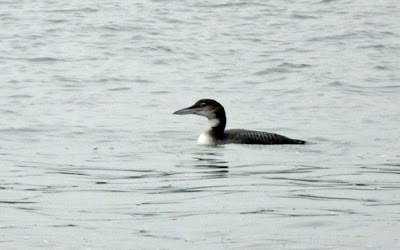
It was about this time a Dorset birder that we hadn't met for quite some time Bagsy aka Paul Baker, a real character that now lives nearby, came along and we were able to have a bit of a catchup and was able to point him in the right direction for the Green-winged Teal.  We walked on across the causeway finding another Great White stood out in the field west of the lakes. We then met George Green and asked him if he had seen the Great Northern Diver and he told us that it's been around the corner of the lake where we were.  Scanning we eventually picked it up as it surfaced and whilst we watched it came real close to our bank and gave excellent views.  There was just one other target species that we hadn't seen and we were told it had been on the small island in the south of the lake but we couldn't find it there.  The sky had darkened and a few spots of rain were felt and I hadn't a waterproof so we decided to start walking back to the car.  As we approached where we had seen the Green-winged Teal we thought we'd take another look and there stood almost next to it was a Cattle Egret, where it came from and how it passed us to get there know one knows, but none-the-less a good way to finish a morning's birding and just as the rain was starting.

Green-winged Teal © Nick Hull

Great Northern Diver © Nick Hull

Cattle Egret © Nick Hull

What a great start to the month's birding but we knew it would be harder to get to the hundred once the lockdown started so next day we went off to Studland and started at Jerry's point in the hope that the Long-tailed Duck was still in the area.  We spent some time scanning the harbour from the shores of Brownsea Island  across to Furzey and Green Islands and into Brand's Bay.  We managed to find Common Scoter and Scaup, we picked up our first Goldeneye but the water was very choppy and birds were hard to find and see on the water. Before we left we added Red-breasted Merganser to our list which were in a raft in the shelter of Furzey Island there was also a diving duck with them with a low profile possible a Long-tailed Duck but we couldn't quite clinch it. We moved on to Middle Beach and checked out over the Poole Bay and only added Black-necked Grebe.  A slow drive through the village didn't produce the Ring-necked Parakeets but we couldn't spend much time here as we were expecting a delivery at home so we called it a day.  Though not quite as we took a short detour on the way home cutting across Hartland Moor in case we could add Hen Harrier or Merlin which we didn't but did see Fielfare and Redwing which was a bonus.

Over the rest of the month which was spent around various location of the harbour we continued to added many of the usual species of wader and woodland birds.  Highlights were a local surprise whilst at Lytchett View on the 4th with a single Egyptian Goose which flew into the bay. Two days later we visited Arne and added Spoonbill to the list with 31 roosting on Shipstal Point. The 19th was a wet and stormy day so we popped around the harbour from Sandbanks ferry back to home the only highlight was single Sandwich Tern on Baiter. Our next was whilst taking a drive around across Hartland and we had a Merlin cross the road at Slepe Copse on the 21st.  

Next morning Ian found a Goosander out in Lytchett Bay and as they are scarce on the patch Jackie and I had a walk to the viewing area at the end of footpath 12. It took a while but we eventually spotted it out in the main channel in the west of the bay.  We had to wait till the 24th to get Marsh Harrier on our Lytchett list when we had an adult female being harried by a couple of Carrion Crow over the Holton side of the bay.  We were now at 99 species and very close to the end of the month we decided to have a drive out to the Cranborne Chase to see if we could add one or two more species to the month's list and indeed we did with Corn Bunting and Red Kite and Yellowhammer.  We finished the day in the Lower Avon Valley where we had 5 Ruddy Shelduck with a large mixed flock of Canada, Greylag and Egyptian Geese in a field between Sopley and Bransgore.

Though it was nice to see the Ruddy Shelduck as they were the 104th species for the month they aren't on the British list as they are considered a feral species from the European feral population and not true wild birds.  I think many birders think perhaps they should be on category C of the British list and countable as the European feral population are increasing and sustainable which is the most likely origin of these super looking ducks.  Also they turned out to be just inside Hampshire. So our month ended on a 103 species.  

Egyptian Goose & Ruddy Shelduck near Sopley.

What will December bring as we can travel a little further round the county hopefully picking up a few more species who knows...


Sunday, 8 November 2020

End of the October Post

Jackie and I started October with a quick visit to a field at Anderson, just past Red Post off the Bere Regis road, where a White Stork had been seen a day or two earlier.  No colour rings had been noticed so if it was an un-ringed bird it may have been a truly wild bird.  I managed to park off the road safely and we scoped the bird which was walking around out in the open and appeared to be eating grasshopper species.  A quick look at the legs and there was a white colour ring and it was found to be one of the Knepp Stork Project birds exploring no doubt.  None-the-less it was still a nice bird to see also whilst we were there we had around 200 Linnet in a flock feeding in the weedy field.  Though as it's a introduced bird it can't be checked off on our year list as its not a truly wild bird but it was still very nice to see.

Jackie and I visited fourteen locations around the Poole Harbour over October and recorded 114 species this is isn't a complete list as many other species were seen by others observers so the potential to seen more was available but they were missed by us. Saying this we had some good sightings we managed to see the Long-billed Dowitcher again before it left, and the two Curlew Sandpiper were still visiting Lytchett Fields. Other highlight for the month were Grey Phalarope (10th), Yellow-browed Warbler and Firecrest (11th), 2 Glossy Ibis (20th), Hen Harrier (22nd) and 27 Spoonbill (29th),  we also recorded our first sightings of Redwing and Fieldfare for the autumn. 

Jackie and I tried three times for the Grey Phalarope and failed to get this bird, then a text from Ian to say it had returned to the fields and we were lucky enough to get to see it.  A really smart little wader and a great addition to our Lytchett patch list and our second in a month.

Grey Phalarope - Lytchett Fields © Ian Ballam

The Yellow-browed Warbler was a really nice year tick and very typically Jackie and I had a lay-in and the  mobile goes off just as I'm about to go to the bathroom and it's Shaun Robson.  "We are ringing at Lytchett Heath and just caught a Yellow-browed Warbler if you can get here quick we will keep it a few minutes".  So it didn't take long for us to be in the car and up the road and join the ringers and see this little gem of a bird in the hand.

Yellow-browed Warbler, Lytchett Bay Heath © Nick Hull

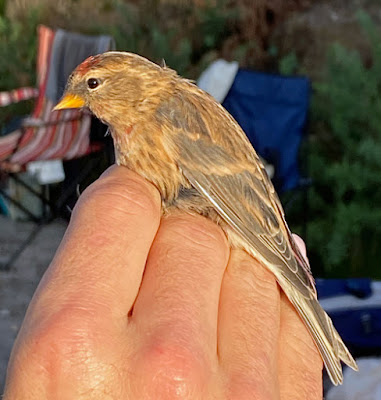
Whilst we were there they carried out another net round and we were lucky enough to see two or three Lesser Redpoll up close as well.

Lesser Redpoll,  Lytchett Bay Heath © Nick Hull

The two Glossy Ibis was a bit of luck and a surprise in some ways.   We had arranged a social distanced walk at Studland meeting four friends to do a little birding around the village.  The area is good in October to pick up Firecrest and migrant warblers plus the added benefit of grebe, divers and sea duck out in the bay.  

We were scanning the bay where we picked up a few scattered Great Crested Grebe a small group of Common Scoter and a couple Black-necked Grebe.  Viewing further out towards the Cruise Liners I picked up a immature Gannet heading towards Old Harry Rocks and got everyone onto it. I then started scanning again, when Liz said what's this over Old Harry now, I quickly got onto the bird and noticed a dark blackish looking bird with legs out the rear and a long neck and a downward curving bill a Glossy Ibis.  It circled to gain height and slowly moved across the bay over the liners and headed toward Hengistbury Head.  I Tweeted the sighting out and added Olly Frampton who about ten minutes later messaged me back to say there were three Glossy Ibis at Stanpit Marsh which had just been joined by a fourth presumable our bird, which was nice to know.  Well we continued our walk around Fort Henry I was scanning the tree tops for the Ring-necked Parakeets when to my surprise another Glossy Ibis flew between us and The Pig on the Beach Hotel heading south towards Glebelands.  Unfortunately we lost sight of it so we're not sure if it cleared Ballard Down ridge and headed over towards Swanage or turned and headed west inland. 

Glossy Ibis taken near Tarifa Spain © Nick Hull

The above shots are just to show you more or less what we saw, as the caption says these were taken in Tarifa in Spain on a Dorset Bird Club birding trip several years ago now.  The top photograph show how distinctive the silhouette is even at a distance.  

We then carried on our walk up to Studland Church and back and as we came to the viewpoint to look over South beach again something disturbed the birds below on the rocky shoreline and there in front of us appears a Great White Egret, which flew off over the wood out of sight which ended our day very nicely indeed.

We caught up on Hen Harrier over Hartland Moor where we also ticked off a flock of Fieldfare with a handful of Redwing in tow and we ended the months birding on the 29th with a visit to Arne where we added 27 Spoonbill to our monthly list.

We are now wondering what will Lockdown 2 bring us now we are into November birding.

Monday, 5 October 2020

Monthly Listing plus VisMig and NocMig & Moths Catchup

I hadn't realised how time has moved on since our last blog, so what has been happening?  Jackie and I have been doing a bit of birding of course mostly locally.  I've had the moth trap out a few times and mid-August started recording nightly nocturnal migration again with varying results.  Also the Poole Pub Birders started a friendly Poole Harbour monthly listing to see who could record the most species in the month though when Mark suggested it he had already started his August list.  So when we arrived at the 1st of September we all started a monthly harbour listing together. Though I have to say Jackie and I haven't taken it too seriously as we have had others things to do, but we put in some time and enjoyed doing what we have and now decided to try a little harder for October, though with the wet weather so far this month we haven't started very well.

For September we recorded 105 species, Mark, who probably put most effort in, recorded a very good 133 species. Ian Ballam also did extremely well when you take into consideration that he concentrated on Lytchett Bay recording area only except for a quick trip to Wareham Water Meadows for the Pectoral Sandpiper/s and recorded 118. 

When the final log was counted there was the potential of 161 species that was possible with in the Poole Harbour recording area. 

To see the Poole Harbour recording area follow this link:-

The birding around the harbour area was pretty good with highlights of two Cattle & Great White Egret, no less than two Pectoral Sandpiper and ending the month with Ian finding Curlew & Wood Sandpiper and Long-billed Dowitcher on Lytchett Fields.
  
Jackie and I tried for the Dowitcher on the day Ian found it on the 29th but just missed it so we returned the next day when Ian messaged me that he had re-found it on one of the roosting Islands. So off we went in the light rain and found Ian watching it just as the rain increased to heavy. None-the-less we managed fairly good scope views of this American wader.  This is the 34th species of wader recorded in the Lytchett Bay recording area since 2012.

Distant Long-billed Dowitcher _ Lytchett Fields RSPB © Ian Ballam

Wood Sandpiper - Lytchett Fields RSPB © Ian Ballam

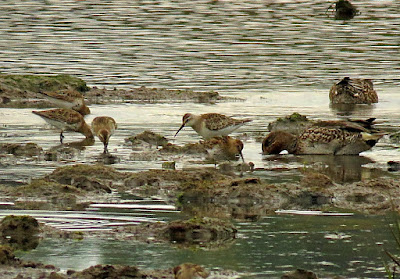
Curlew Sandpiper, Dunlin & Teal - Lytchett Fields RSPB © Ian Ballam

Visual Migration from Ballard Down and South Haven produced large numbers of Siskin moving with lesser numbers of Meadow Pipit, Chaffinch, Greenfinch and Crossbill. We also recorded three Great Spotted Woodpecker moving north during one of our Vismig morning. Also Jackie and I managed to catch-up at long last with Spotted Flycatcher in the willows at South Haven on one of our mornings outings.

As mentioned earlier above I've started recording nocturnal migration again for this autumn from the middle of August. So far to date The notable species for me here were Lapwing, Ringed Plover, Common and Green Sandpiper, Whimbrel, Moorhen, Coot, Snipe and of real interest was the first Redwing and a single Ring Ouzel recorded on the morning of the 28th September and a flyover Bullfinch on the 30th.  Also of interest was the recording of Barn Owl on three occasions during September. Tree Pipit and Meadow Pipits were commonly recorded and a couple of Moorhen and four Coot were considered migrants passing over in the period. 

This is a very nice recording of a flyover flock of Lapwing at 22:29hrs on the 6th September.
 
Below sound is the Ring Ouzel recorded at 01:36hrs on the morning 28th September


This is the recording of the first Redwing recorded at 01:39hrs morning of the 28th September

Other species recorded were Fox, Squirrel, Sika Deer Stag first heard on the 24th September which is the sign that the stags are getting their testosterone up for the start of the rut.  I also had several nights where I was recording frog croaking from around the garden but the most surprising was a cow bellowing early one morning and the nearest cattle are at Holton Lee across the bay, also surprising was a Cockerel crowing one morning, I have no idea where that resides.

The September mothing produced the usual species expected here in my Upton? Lytchett Bay garden but ended the month with two new species of macro moth. Heath Rustic Xestia agathina and The Anomalous Stilbia anomala with a supporting Rusty Dot Pearl Udea ferrugalis a micro which has been considered a migrant but a friend has found caterpillars of this species this year so may now be breeding successfully in the county now.

Heath Rustic Xestia agathina

The Anomalous Stilbia anomala 

Rusty Dot Pearl Udea ferrugalis

Sunday, 9 August 2020

Catching up with Scarce and Rare Inverts

You have probably read this here before that I feel that I'm pretty lucky to live here in Dorset as it holds some pretty special wildlife which can't always be found in other places.  Some of these species appear to be doing very well here within the Poole Harbour basins Heathland and Bogs.

Since the easing of Lockdown Jackie and I have been catching up on some of those special species that we are lucky enough to still be able to see locally.  The first was a very local and very new arrival to Dorset found by Ian Ballam here on the Lytchett Bay patch in 2018 and last year we observed several pairs.  So Ian and I kept looking for the first emergence this year of the Southern Migrant Hawker or Blue-eyed Hawker (Aeshna affinis) as it is sometimes known as.  This latter name I think is much more appropriate now that it has been breeding in the UK annually since around 2010.

Southern Migrant Hawker - Lytchett Bay © Nick Hull


We had to wait until the 23rd July when Ian texted me to say he had a male over the dried pond a habitat that this species prefers.  Unfortunately though it has been seen by quite a few Odonata twitching people we think we have only got the one male this year and it's been very hit and miss if you are lucky enough to catchup with it when you visit.

Our next quest was for Turtle Dove, a species we had tried for already but failed to see or hear even though we knew they were present.  We chose a fine warm morning with a gentle cooling breeze and hoped that might be enough.  


It wouldn't be me if I didn't try to include at least one bird sound into the blog.  This is one of about four Turtle Dove that we heard I just love the gentle purr that they have and accompanied by a Skylark what can be better.

The next excursion was just me and two friends, Terry and Kat, we are part of the reptile survey team at RSPB Arne, due to the lockdown some of the work that had been planned hadn't taken place.  So as it's something outside we could do easily and distance from each other we were allowed to recommence the unfinished work. This was to replace some old felt Artificial Refuges (AR's).  These if you do not know are bits of tin or felt left for reptiles to warm up on.  The day we chose turned out very hot so no reptile in it's right mind would be on or under one of the felts which we were to replace with tin, indeed we never saw one reptile the whole day. So why are you relating this account, I here you ask, well whilst carrying out our volunteer work we had a surprise, well I did.  At one location we had removed an AR at the end of February but was unable to replace it at the time, it had left a bare square in the heather so it was easy to find.  So I grabbed a piece of tin and walked up to replace it.  When I was a few metres away a Nightjar flew up from the bare patch and talk about make me jump and there on the dried patch were two eggs. I took seconds to take a quick photo and I backed away.  We will not return to the area again until after the breeding season has finished.

This is the view I had of the Nightjar nest & eggs taken with a long lens © Nick Hull

This is the same photo just heavily cropped © Nick Hull

On Fridays as a rule Jackie catches up with one of the daughters and I go off doing wildlife things.  So I met up with Terry to check out a few areas for scarce invertebrates and to see if we could get a few presentable photographs. Though Terry is much more the photographer than I am.  We started for the Southern Hawker then on to a site I know for a melanistic Adder but unfortunately the temperature was again rising quickly and it was becoming too hot.  So Terry led the way to a pond for a very rare Pondweed Leafhopper (Erotettix Macrosteles) cyane) which he picked up straight away and once I got my eye I counted a least 85 and the previous week Terry said they had only around 20.  This Pondweed Hopper is very particular about the ponds it inhabits and is a good indicator that there is no pollution of any kind and because of this they are very vulnerable. 

Pondweed Leafhopper Erotettix (=Macrosteles) cyane © Nick Hull

Next we went off to a bog where we knew there was Large Marsh Grasshopper this is as it name suggests is a large species, the males are green and the female are a super deep red and they are stunning animals.  They make a tick like sound a bit like a electric fence shorting out on a metal post, or as someone recently likened it to the snap of the gorse seeds popping out on its pod on a hot day.  It took us a while to locate one and then another an so on but to get one to pose for a photo wasn't easy but with patience we manged to get a shot of both male and a female.

Large Marsh Grasshopper Stethophyma grossum © Nick Hull

I managed to find a Bog Bush Cricket which was an added bonus this species is a little like Roesel's Bush Cricket but is generally darker and found in much wetter areas hence it's name.

Bog Bush Cricket Metrioptera brachyptera © Nick Hull

Though Cricket species can look similar to grasshoppers the easiest way to tell the difference it check the length of the antenna and cricket antenna are very long and grashoppers are short and stubby in comparison.  We also found a single Marsh Gentians which looked quite lonely on it's own though I suspect not for very much longer.

Marsh Gentian © Nick Hull

We also checked out a few other site but the wind was picking up and not suitable so we decided to call it a day.

It wasn't until a week or so later that Jackie and I met up with a few friends for a heathland walk and I managed to find my first ever Heath Grasshopper.  A pretty rare species but seems to be doing ok in and around the Poole Harbour Heathland where the habitat is right for it.  They are a very cryptic coloured species which has three main identifying features and they are :-

Heath-Grasshopper Chorthippus vagans © Nick Hull

1. The underside is densely hairy. 
2. The marking on the pronotum reach the edge.
3. The wing has a distinct bulge on the edge of the forewing.

Heath-Grasshopper Chorthippus vagans © Nick Hull

You can see the bulge on the forwing of this individual very well as it's missing a rear leg.

Well I think that brings you all up to date.