About Two Owls

Tuesday, 11 July 2023

June and our Tour de France Part 1

The last week on May and the beginning of June was taken up checking out wildlife for the coming SpringWatch programme and informing the cameramen where we were finding things.  Though for me helping out ended on the 31th May, as I needed to pack as Jackie and I were off to France visiting friends and looking for wildlife.

The plan was to sail from Portsmouth to St. Malo and from there drive down to the Loire overnight then continue down to the Gironde where we would meet friends and explore the local area.  After a week in the Gironde we moved on to the Western Dordogne to the Auberge de Castel-Merle near Sergeac. Staying there for four nights before moving back up to the Loire for a stopover before heading to Normandie for another four nights before catching the Ferry home to Poole from Cherbourg.

Our overnight crossing to St. Malo was uneventful and we were lucky it didn't take long to disembark and to get on our way.  We arrived at our overnight stay Hotel Le Relais du Bellay around midday we checked in and decided to go and visit the Abbaye de Fontevraud just a few miles away. We had visited here many years ago as it was a location for Rock Sparrow.

Abbaye de Fontevraud internet photograph

The first permanent structures were built between 1110 and 1119. The area where the Abbey is located was then part of what is sometimes referred to as the Angevin Empire.  The King of England,  Henry II, his wife, Eleanor of Aquitaine, and their son, King Richard the Lionheart, were all buried here at the end of the 12th century. It was seized and disestablished as a monastery during the French Revolution.


The Abbey is situated in the Loire Valley, a UNESCO World Hertage Site, between Chalonnes-sur-Loire and Sully-sur-Loire within the Loire-Anjou-Touraine French regional natural park (Parc naturel régional Loire-Anjou-Touraine).


The complex of monastic buildings served as a prison from 1804 to 1963. Since 1975, it has hosted a cultural centre, the Centre Culturel de l'Ouest.


We had a good explore around the village and Abbey and we didn't set eyes on a Rock Sparrow though I'm pretty sure at one point I heard one calling but we couldn't locate it. What we did have was several Black Redstart and lots of Swift and a few Swallow which were all very nice to see.


Me watching the Swift come into their nest sites

By the time we arrived back to the hotel we just had time to have a wash and brush up before we had to make our way to the restaurant which Jackie had booked online. It took us a while but we wound our way through the streets down to the restaurant which was next to the river as was our table, giving us a very nice view.


Jackie at the riverside restaurant 


Whilst we were waiting for our meal I noticed near to the edge of the river bank two spikes of Ivy Broomrape.


Ivy Broomrape © Nick Hull


Walking back to our hotel we were walking past the Châteaux when we heard a Eagle Owl and some alarm screechy sounds what seemed to come from a nearby tree in the grounds on investigation it appears it must have been some kind of noisy deterrent perhaps to keep Feral Pigeons away from the building.  


The  Châteaux from where the bird sounds came from © Jackie Hull


The delay was somewhat fortunate as we continued towards our hotel Jackie and I heard a 'Quak' sound high above us, we both looked skyward and two Black-crowned Night Heron were flying over.  We finished our evening listening to a Black Redstart singing from the chimney of the building across the street from our room a really nice way to go to sleep.

Black Redstart


Next morning before we headed for the Gironde and our Gite where we would be staying for the next week. Jackie and I wanted to visit a site just to our south near Loudon where we have had Little Bustard in the past which was only a half hour drive away.  We stopped on the road verge and got out of the van to have a listen and the first sounds heard was the jangling of Corn Bunting then Melodious Warbler followed by Golden Oriole, Turtle Dove and Cirl Bunting.  We continued around the circular route and the only other note worthy birds was Honey Buzzard, Nightingale and Zitting Cisticola but there was no sign of Little Bustard or Stone Curlew. 


Corn Bunting near Loudon

After doing the circuit without any luck we headed for the Gironde where we found ourselves a few hours later.

We soon unpacked and had a look around the garden and the first thing you noticed was the Honeysuckle and it was covered in Hummingbird Hawk Moths zooming everywhere and it was like this everyday we were there, it was fantastic.


Hummingbird Hawk Moth

The Gironde is formed by the juncture or the Garonne & Dordogne rivers and flows into the Bay of Biscay.  The estuary is edged by Maries (marshes) and as you move inland you have the many vin yards that produce Pineau des Charentes a favourite of mine, and the many wines of the Bordeaux region. 

This year they were in the middle of a very dry period having no rain for sometime and the temperature peaked around 30-35ºC most days so birding was carried out in the mornings when is was a little cooler and the birds and wildlife were more active.

The next day our friends, Hazel & Ron, took us inland to a gravel extraction site, we had been there before on a previous visit for Bee-eater but when we arrived at the site it was very busy and we thought best not to go in with all the heavy trucks moving around, plus we couldn't hear or see any Bee-eater.  Anyway Hazel had a backup and just a mile up the road there was another quarry, but as we parked up and got out of the car we could hear the distinctive calls of Bee-eater and it wasn't long before we had located them and getting good views.  

European Bee-eater © Nick Hull

Later the same day we visited a forest site for butterflies.  At this site we added a few butterflies one being pretty scarce and a few day flying moths and a rare damselfly and an orchid. 
First the day flying Moths.

Burnet Companion & Mother Shipton © Nick Hull

5 Spot Burnet & Faust's Burnet © Nick Hull

Butterflies here were few but one of them is fairly scarce and the other was pretty common but not found in the UK.

Pearly Heath & the scarce False Ringlet

We also came across a species of damselfly which was obviously an emerald species but not that of Common Emerald which we find at home so I took a couple of shots and later researched which species a could have been and it turned out to be Scarce Emerald Lestes dryas or Robust Spreadwing.

Male and Female Scarce Emerald Damselfly © Nick Hull

Jackie found this lone Bee Orchid on the grassy verge along the forest ride.

Bee Orchid © Nick Hull

Next day we explored the marshes something we did several times and managed to pick up many of the local species. Such as Black-winged Stilt, Cattle Egret, though usually we see Red-backed Shrike on the marshes but we actually found them in the scrub areas near to the grape vines further inland.


The species that we came across most were Black Kite, Nightingale, Zitting Cisticola, White Stork, Black Redstart and House Sparrows with Red-backed Shrike and Hoopoe also putting in regular appearances. There also still seemed to be good numbers of Turtle Dove in the arable areas. On our travels around the marshes we were taken to an area where a pair of Black-winged Kite are regularly seen and we were lucky enough to find them.  This species has had a rapid expansion in its distribution and is moving up through France very quickly and it wouldn't surprise me if we do not see them here more regularly over the next few years. Our last visit was in 2018 when there were only a couple of pairs this last winter 2022/23 there were 40 in the roost.


Not the best shot of the Black-winged Kite pair but we didn't want to risk disturbing them

We found the Black-winged Stilts in an old salt pan and there were good numbers nesting and a Black Kite came drifting over and all the male birds lifted off and escorted the kite away which enabled me to get several shots like this male flying over and alarm calling.

male Black-winged Stilt © Nick Hull

We came across a number of Cattle Egret this one was with four others accompanying a small herd of Limousin cattle.  As you can see we had a thunder storm hence the wet bedraggled look of this individual. 

Cattle Egret © Nick Hull

In previous visits we found a good number of Red-backed Shrike in the area but this time they seem not so common.. Though we did find birds in and around the vineyards in areas of scrub we also found a few Hoopoe in these areas to.

Male Red-back Shrike © Nick Hull

The White Stork population seems to be doing ok and we came across a number on nesting platforms all of which were occupied.

White Stork platform and stork family © Nick Hull

During our stay in the Gironde we didn't see many mammals though I saw the briefest view of a Pine Martin as it dashed across the road on our way out for mothing one evening and on the marshes we saw Coypu which seems very common throughout Western France. 

Coypu in one of the Marshland Dykes © Nick Hull

Unfortunately we had missed the main orchid flowering period though we did see a few on our travels. 


I had a night out in the forest with Hazel mothing where we managed 72 species, a few were new for me as they are not found in Britain and a few are very rare vagrants to the UK which were good to get experience of just incase one turns up in the trap at home.


The method used by Hazel is a metal frame a bit like a cloths rack which has a white netting stretched over it with two blue UV lamps placed along the top rail and a white sheet placed on the ground under the frame. The method works well and would be ideal for doing a mothing introduction demonstration. 


Hazel checking for micro's on the netting © Nick Hull

We caught six species that were completely new for me which haven't been seen in the UK and one that is found on the Channel Islands which hasn't been recorded on mainland Britain. The following two species are both rarely seen in the UK.


The Passenger & The Latin both rare visitors to the UK © Nick Hull


These following two are micro's which get overlooked by many that go out moth trapping but than can be very nicely marked though my photographs do not do them justice.


Eurodachtha pallicornella & Acrobasis porphyrella © Nick Hull

This one had me confused but it turned out to be a Jersey Emerald but it wasn't green like others I had seen before but it was one that Hazel catches regularly here in the Gironde.


Jersey Emerald found on the Channel Islands but hasn't made mainland Britain yet. 

This last photograph I've put here as I've caught Pale Oak Beauty in the home trap but never Great Oak Beauty and I have always checked the beauty species but will not need to again as when you see the size difference between Willow Beauty and Great Oak Beauty there is no comparison.

Willow Beauty & Great Oak Beauty © Nick Hull

We had a little by catch with the appearance of the super millipede species. It's one of 593 species that are in Europe, compared to 62 in the UK.


This is Cylindromyia bicolor which appears to be thinly spread across Europe.

This is a Lesser Stag Beetle which is relatively common but still nice to see.

We had a couple of mornings when it was a little cooler so we checked out a couple of forest sites for Butterflies and found some nice fritillary species.  I'm not sure but I doubt there is a site in the UK that you could visit and get six species of fritillary along a half mile forest ride.

Weaver's Fritillary & Small Pearl-bordered Fritillary © Nick Hull

Spotted Fritillary & Queen of Spain Fritillary © Nick Hull

High Brown Fritillary & Knapweed Fritillary © Nick Hull

Our week in the Gironde soon came to an end and we had to say goodbye to Ron and Hazel and thank them for showing us such good wildlife around their area it was fantastic and we have only shared a summary of the better species here.  Next we move on to the Dordogne for a short stay before an overnight back in the Loire on our way back north to end with a few days in Normandie all to come in the next Blog.

Friday, 30 June 2023

May is coming to an end and it's been a slightly different month for us as we've only added a few birds to the year list but we've been adding Butterflies and various Odonata to the months sightings and one or two beetles.  

Our month started with a walk around the Lytchett Bay Patch where we saw nothing unusual and only recorded a handful of migrants, Whimbrel out in the bay and a number of Swallow moving through towards the north.  The Chiffchaffs were in good song having been on territory for a few weeks now, also we had a male Reed Bunting singing which is not the best song in the world but very nice to hear and know we still have a few breeding territories in the reed beds here. One of our problem is the number of Sika Deer that moving around the reed beds they create paths and flatten the reed and constantly disturb any of the reed nesting birds and we think this is the main reason for lower numbers of breeding territories of Reed Warbler and Reed Bunting around the bay.  It's a real problem with know simple answer though on the upside these paths seem to benefit the Water Rail population which seem to be doing ok.

Holly Blue - © Nick Hull

On the 2nd we headed out of county to Titchfield Haven to meet up with a friend we haven't seen for a while and we did a little birding on the reserve before lunch.  When we arrived the warden team were putting out the nesting rafts for the terns so there was a little bit of disturbance but we were able to see our first Common Terns for the year.  We also had good views of a displaying Sedge Warbler and from the first hide which was the most productive there were a few Avocet which a few breed here on the lagoons most years. Though we didn't see the Roseate Tern which had been observed there on the previous day, probably moved through to its northern breeding grounds.

Sedge Warbler © Nick Hull

On the 8th we had a quick trip to Longham Lakes where we added Swift in fact around 50 swift and heard our first Cuckoo of the year.  Next day I had a couple of hours at Durlston CP NNR on Purbeck doing some sound recording but unfortunately the sea breeze became to strong and brought in a damp mist so I called it a day and gave it up as a bad job. Though I did hear around three Lesser Whitethroat but due to the wind the recordings aren't very good but I had to try.
a few of the 50+ Common Swift at Longham lakes © Nick Hull

On the 14th we were Osprey monitoring along four hour stint but what is nice now we don't need to keep it a secret as the Birds of Poole Harbour have announced there are public visiting and to book tickets and see availability follow this link 
They are popular so hopefully there will be lots of opportunity just keep checking in.

Osprey Screen Shot from the Birds of Poole Harbour Web Cam

On the 15th Jackie and I was just about to leave to go to Durlston when a a text from Ian a fellow patch watcher said I've just had a Little Gull in the mouth of the Sherford River from the Rock Lee VP. So we quickly went and joined him just as the bird disappeared but fortunately we managed to re-find it stood on the mud with a Black-headed Gull. Though Little Gull is on the patch list it was a new tick for Jackie and me.  By the time we left the view point it was getting towards lunch time so we decided to abort our visit to Durlston and we would have a look over Lytchett Heath.  This turned out quite a good decision as we added Dartford Warbler and Stonechat to our patch year list.  In fact the latter has been very scarce on the patch since the winter and was certainly my first sighting of one this summer. Even on my heathland survey plot which I did next day (16th) which added a little excitement to the survey but not quite as much as the Wood Warbler which was singing from a small group of birch trees. Though I think it probably will not be staying but just moving through on migration.  Which is a shame as they have become a very scarce breeding species now in the county and even in the New Forest.

An after evening dinner excursion to North Dorset with the sound recording equipment on the 20th was partially successful in that we heard our target species but again the wind was just a little to strong for a good recording of the Nightingale that was singing in the complement of Blackbird and Song Thrush.


On the 24th whilst taking part on a pond survey for odonata in the new Purbeck Heath NNR I had a Nightjar singing during the day which was a bit odd but not that unusual to happen which was a nice year tick. Now all I have to do is take Jackie out so she can hear one as well.

On the insect front Jackie and I have recorded 19 species between the 17th Feb to 25th May. The early species in March were the usual over wintering species Small Tortoishell, Peacock and Brimstone.  Then we added Orange-tip, Comma, Speckled Wood and Green-veined White in April.  Then May saw us add 13 to the list.
Holly Blue, Small Copper, Dingy & Grizzled Skipper, Common & Small Blue, Red Admiral, Small Heath, Green Hairstreak, Brown Argus, Large & Small White and Wall Brown.

Brown Argus © Nick Hull

The Dragonflies and Damselflies have been a slow start with Large Red Damselfly and Hairy Dragonfly being the first then during the PHNNR pond survey on the 24th I recorded 8 species just over one pond and a 9th over another. the list so far is as follows.
Large Red, Common & Azure Damselflies, Beautiful Demoiselle, Hairy Dragonfly, Downy Emerald, Emperor Dragonfly, Four-spotted and Broad-bodied Chaser and Red-veined Darter.

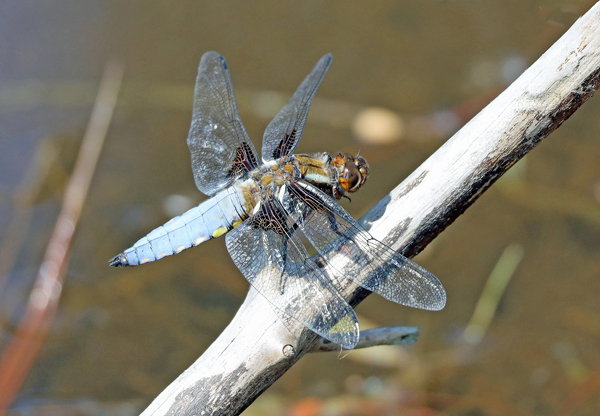
male Broad-bodied Chaser © Nick Hull
Other species seen in May.
Whilst I'm surveying for RSPB or the PHNNR we are looking for particular species usually those scarce and rare residents which we have a few ie Purbeck Mason Wasp, Heath Potter Wasp, Smooth Snake, Sand Lizard etc. As this means we have to walk sometime from one area to another from one pond to another we always look for other species that catches our eye and if we do not know the species we photograph it and try and identify it later at home with internet search or if that fail contact local experts etc. Most of course are mostly common species but on occasions we turn up something that is a little rarer.

Here are a few common species that we've seen this month.
This species of Crab spider can change there colour depending on which plants they are on I don't think this one has worked it out yet.

Crab-Spider_Misumena vatia © Nick Hull

Green Tiger Beetles are a pretty formidable beetle and is a real predator with strong set of jaws this is a female as it has the two dark spots above the yellow spots on the eyletra, they are absent on males.

Female Green Tiger Beetle © Nick Hull

This Oak Eggar caterpillar was enormous it appeared it was looking for somewhere where it could safely pupate 

Oak Eggar Caterpillar © Nick Hull

This beetle is a species that is fairly common it can be found in old established deciduous woodland where tree are in various stages of decay.  It can also be found at the base of heather on sandy peaty heathland which is where we found this individual.

Nalassus laevioctostriatus © Nick Hull

This next beetle typically occurs in woodland and moorland habitats and especially in upland areas. They are medium to large carabids, all are unmetallic black and most are of a characteristic appearance which soon becomes obvious with experience.

Abax parallelepipedus © Nick Hull

A couple of the rarer species we found this month. Both of these beetle are rare the Heath Dumble-Dor Beetle in a dung beetle is predominantly a species of southern lowland heathland, with most recent records have come from Dorset, Hampshire and Surrey.

Trypocopris pyrenaeus - Heath Dumble-Dor Beetle © Nick Hull

Agonum sexpunctatum is a rare ground beetle in Dorset which is a heathland specialist. Adults are diurnal, they move fast as they hunt for springtails and small insects.

Agonum sexpunctatum © Nick Hull

A relative to the Green Tiger Beetle is the Heath Tiger or sometimes called Wood Tiger Beetle is another formidable hunter with fearsome jaws and are quick across the ground to catch their insect prey. We survey this species annually and a lot of work has gone into making suitable habitat to help them increase their numbers which seems to be working but more work is required as always.

Heath or Wood Tiger Beetle © Nick Hull

I ended this week going to find Wall Lizards for a forth coming tv program and after arriving at the site it took us a little while to find the correct location and managed to see at least 8 individual scurrying around the rock walls and amongst various vegatation searching for food.  Also one or two males were chasing the females, as the one in the photograph below is stimulating the female by giving her little nips to her body.

Common Green-backed Wall Lizard © Nick Hull

On the 28th Jackie and I visited Cerne Abbas DWT reserve we haven't been there for a few years though we didn't find any Duke of Burgundy or Marsh Fritillary though we did meet another couple who had seen the latter.   It was a little windy to be ideal for butterflies but we did see a few Forester and 5-spot Burnets on the wing, all very fresh so obviously very recently emerged.

The Forester Moth on a Common Spotted Orchid © Nick Hull

Five-spot Burnet Moth - © Nick Hull

Thursday, 11 May 2023

March/ April Update

March 
I think is always a slow month when you are still trying to get those odd winter species that you haven't seen and towards the end of the month there is that expectant feeling of an early migrant.  The weather was pretty awful and wet which limited birding somewhat and Jackie and I managed to get out and around ten times over the month mostly local around the harbour.

We only managed to add five species to our year list Knot, Greenshank, Red-legged Partridge, Skylark and Spotted Redshank.  We also had a unexpected sighting though fairly brief of a male Cirl Bunting at the Sheeps Pen car park at Encombe, Isle of Purbeck, which has to be the highlight of the month.

So our year list stands at 132 species which I think is pretty average but as we don't twitch very much these days only really going for lifers trying to reduce our carbon footprint, I don't thinks we are doing too badly.  The photograph below is from our archive just in case you can't remember what one looks like.

male Cirl Bunting taken in Normandie © Nick Hull

April
April in contrast to March couldn't have been more different with something like 32 new species for the year list though not all in Dorset.  As at the beginning of the month Jackie and I had a few days down on the Somerset Levels as I wanted to try and sound record Bittern.  

We started our birding on the levels at Greylake RSPB reserve to see if we could find a Garganey which was reported to be there.  Well it was and we saw it almost as soon as we looked out of the hide and it wasn't too far away.

Male Garganey having a wing stretch - Greylake RSPB © Nick Hull

We had our only view of Bittern here or rather I did as Jackie didn't get on to it quick enough before it dropped into the reeds out of sight, a pretty good start to a few days away.  We then headed off to Ham Wall and had lunch before walking over to Shapwick Heath. As we were heading up along the channel path we started to hear the booming of Bittern and I started to do a little recording but there was really to much background noise, but none the less I managed some. It also gave me an idea of where I needed to be the next morning.

On the 3rd Jackie and I were up early had breakfast and out in a cool frosty morning and arrived at the Ham Wall car park just after opening heading back to the spot I had been recording the evening before.  We stood in the quiet of the morning and as the birds woke and started to sing therir territorial songs.  I set up the recorder and recorded Blackcap, Cetti's, Willow Warbler, Chiffchaff and Reed Bunting and then we heard a distant boom.  In fact over the next hour or so we pretty sure we had recorded at least five Bittern Booming from the one spot and one was so close it vibrated the parabola dish it was amazing to hear with the headset on.


As people started to arrive I gave up on the recording and we did a little birding from Noah's Lake hide where we added Barnacle Goose to the list.  We heard that two Cranes were showing well at Catcott Lows so we headed off in an attempt to try and see them.  On our arrival we were told they had just flown off a few minutes earlier. So after having a good look around we headed back to Ham Wall and spent the afternoon there. Where we caught up with the long staying Glossy Ibis saw two pairs of Garganey and several Great White Egret, plus all the usual more common species. As we were leaving and nearly back to the car park a flight of Greylag Geese flew in and one was obviously smaller getting on to it, you could see it had a white forehead blaze identifying it as a White-fronted Goose.  We spent the last part of the day at West Hay where we listened to Bittern booming and lots of Swallow and Sand Martin feeding over the reed beds and recorded our first Reed Warbler of the year. As we headed back to Meare where we were staying I made a wrong turn and we drove around in a bit of a circler route to get back onto the correct road. Which turned out to be very fortunate as we came across a Barn Owl which gave good views as it quartered over the fields.

Back home our next outing was to Blashford to catchup with the female Scaup which we just managed at the last minute just before we were to leave, thanks to Lorne Bissell. We also added Little Ringed Plover on the edge of Ibsley Water.  

On the 8th of May Jackie and I were on domestic duties when Jackie called something is upsetting the Herring Gulls then she shouted "Osprey" I shot out with the camera and managed a few shots as it soared over the garden carrying a fish before it headed off northward.

The gull warning system & Osprey © Nick Hull

Same Osprey with fish © Nick Hull

That afternoon we had a drive up around the Cranborne Chase and stopped off at Wyke Down where I managed to see a male Hen Harrier but failed to get Jackie onto it in time before it disappeared over the ridge.

It was another eight days before we managed to get out to Lodmoor with friends and had a pretty good day adding Common Sandpiper, Sandwich Tern, Grasshopper and Reed Warbler and a stunning male Pied Flycatcher.

Male Pied Flycatcher - Lodmoor RSPB © Nick Hull

The next day (17th) Jackie and I did our Osprey watch and managed to add Woodlark and Mistle Thrush to our 10km list and on the way home I noticed lots of gulls feeding in with the cattle by the Post Green road. So we stopped and had a brief view and found over 50 Mediterranean Gull and 3 Wheatear in the field which were also added to our 10km checklist.

On the 21st Jackie and I had a second try for the Night Heron that had been seen by the Stour at IFord, Christchurch, We had dipped on the previous visit as the birds were flushed by a dog walking along the north bank.  Well we arrived and walked the 120m or so up river from the bridge and there sat on a branch over the river was one of the three Night Heron that had been present in the area for about a week.

Night Heron River Stour Iford © Nick Hull

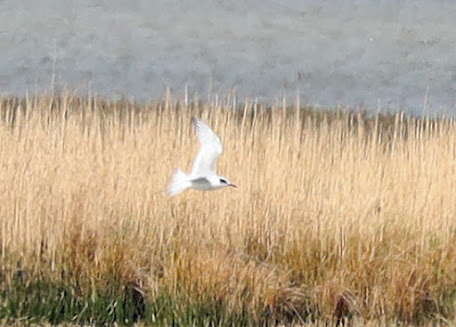
Over the next eight days we had a run of good birds we started just with our first Whimbrel in Lytchett Bay on 23rd that evening a Forster's Tern was seen from the new Rock Lea view point but next day it was back in the bay and Jackie and I managed to see it distantly at first from Footpath 12 before moving to the Lytchett Bay view point where we had good scope and bins view of this rare American tern. It was still a little distant to photograph but I managed a few passable memory shots of this second for Dorset.  The first was at Ferrybridge in 1996 which we also saw.

1st/winter Forster's Tern - Lytchett Bay © Nick Hull 

On the 25th we had arranged with a friend to visit Durlston CP. to go and find some orchids and catch up on a few sea going species absent from our lists.  We added three before lunch Guillemot, Razorbill, Fulmar, whilst we were thinking of going for lunch a message came through to say there had been a Woodchat Shrike found at Herston, Swanage so once we had replenished ourselves with food and drink we headed off to see if we could find it.  After sorting out where we had to be, we eventually found it sat in a some gorse and bramble scrub where it gave us good views.

Woodchat Shrike - Herston © Nick Hull

But the month hadn't ended nor had the good birds as on the 29th a Dotterel was found between Renscombe Farm and St Adhelm's Head just as Jackie and I was leaving the house on our way to see if the Black-winged Stilts were still on Lodmoor.  So fortunately we changed plans and headed to Purbeck.  Around forty minutes later we were stood watching a distant Dotterel and a couple of accompanying Golden Plover on a recently cultivated field we also saw two Wheatear as well. 

Female Dotterel - Renscombe © Nick Hull

Which as it happened it saved us wasting a journey to Weymouth as the Black-winged Stilts had left left.  We ended the day by adding Yellowhammer to our year list at Wild Woodbury on the way home. Bringing our total for the month to 121 species and 164 for the year. With plenty to still connect with.

Tuesday, 7 March 2023

February 2023 Roundup

January finished with a credible 114 species on our list though a handful of these were not local or in the county but according to my BirdTrack summary I entered 602 records and completed 34 lists from 36 location.  With highlight of three American rarities at Ham Wall it wasn't a bad start to the year's birding, but would February be as good?

We began February with a visit to Acres Down in the New Forest joined by friends. It was cold and overcast and it wasn't a great morning for birding but we persisted with very little gain although we managed to add Stock Dove and bird of the morning was two super Firecrest.  In the afternoon Jackie and I went on to Hurst Spit to try for the Shorelark unfortunately as we were walking out towards where the bird was being viewed a dog walker walked along the shoreline and flushed it out into the marsh and we missed it, though I doubt it will be our last dip of the year.  So overall not a memorable day.

pair Stock Dove - New Forest 

We were back on the 10km patch on the 5th Feb and spent a couple of hours around Middlebere adding Dartford Warbler to our list. Next day it was birding on the Lytchett patch whilst doing a little volunteering at the same time.  My little bit of litter picking and trimming back of gorse and brambles overhanging the footpath was to be rewarded with sightings of Red Kite and White-tailed Eagle. The same night, just as I was off to bed, the Tawny Owl called from the wood across the road  which made a nice end to the day.

On the 14th we managed to add Barn Owl to the 10km patch, which is a very good bird as there aren't many pairs that can be found in the harbour area now.  Our next outing was with friends to Radipole Lake RSPB adding our first Cetti's Warbler and for me only Bearded Tit fortunately I just happened to be looking in the right place when two flew across a gap in the reed bed calling and disappeared straight away.

Drake Pochard photographed at Radipole Lake  Nick Hull

We added Yellow-legged Gull at Longham Lakes on the 21st and had what must be our largest flock of Pochard we have seen in a few years of 118 mostly males.  It's odd that this species has declined as a wintering visitor to East Dorset once Little Sea and Poole Park would see large numbers in winter but sadly not the case anymore. Looking back over the years Poole Harbour counts would be around 350 wintering birds annually.  The most recent report states the peak counts in Dorset were 500 on the Fleet & Wey combined, 60 for Longham and 21 for Silverlake.
The Poole Harbour record for Pochard was in February 1963 when 2,801 were counted in Poole Harbour as a whole.

On the 22nd just after having a late lunch we received a message from Shaun Robson to inform us that there was two Common Crane soaring over Lytchett Minster so we quickly grabbed our bins and we were off heading towards the the Upton Flyover when we received a second message to say they were drifting towards Lytchett Fields.  So we headed to the bottom of Slough Lane and quickly jumped out of the car and started scanning the sky over the fields.  I quickly picked them up as they drifted towards the south and disappeared out of sight.

On the 24th I was up early and out to Holton Lee on a Woodlark Survey unfortunately it was a little cold for ideal conditions but none-the-less we walked the heathland areas but no Woodlark were found or heard but there is still time. The only consolation was I heard Green Woodpecker which is getting harder to find around the Lytchett Bay area these days.  

After getting home and joining Jackie for breakfast we headed off to Studland to see if we could find the reported Velvet Scoter out in the bay but another dip but we did see the 'Studland Three' Ring-necked Parakeets noisily flying around near the Pig by the Beach Hotel.

Rose-ringed Parakeet (The Studland Three) 

We ended the month back at Acres Down with our two Godsons who have recently gotten into birding.  They particularly wanted Lesser Spotted Woodpecker and Hawfinch.  We tried for the lesser spot first but only had it drumming distantly but we had brief views of two Crossbill flying over.  Moving up to the raptor view point it soon became obvious it wasn't the weather for birds of prey. In fact there wasn't a buzzard to be seen let alone anything else. We went to over towards the east and here we had some luck 4 Hawfinch flew in and perched up on the top a Silver Birch and I managed to get one of them in the scope and had good views.  As we started back to the cars I caught sight of a flock of approx 25 birds flying in and as they crossed our path I realised they were also Hawfinch but they didn't stop.

We had lunch at Eyeworth Pond in the hope of seeing Mandarin but couldn't find them but had good views of Marsh Tit which were year ticks for us and lifers for Nat and Frank, so a good end to the mornings birding.

Blue Tit and Marsh Tit - Eyeworth Pond © Nick Hull

So by the end of February we stand at 127 species from 1004 records having visited  51 location. So we added 13 species to our year list in February.

What will March bring first Sand Martin, Osprey, Wheatear and towards the end on the month Tree Pipit and perhaps an early Redstart.

Wednesday, 8 February 2023

2022 come to an End & 2023 Begins Slowly

End of 2022 and Beginning of 2023

Jackie and I started the month with the hope of catching up on a few missing species, but and yes there is always a but Jackie and I picked up what is now known as the 'Not Covid Cough' virus which put us out of action for just over two weeks. Towards the end when we thought we were recovering Jackie had a coughing fit which ended with her going to hospital for an X-ray on her back and found she had fractured a vertebrae in her lower back so birding was out of the question until she recovered. Though at writing Jackie is improving and we managed to get a little birding on New Years Day to get 2023 off to start 

So over month (December) only 26 species and only two added to the Poole Harbour and 10Km list they were Jack Snipe and Woodcock thanks to Birds of Poole Harbour ringing project. 

Jack Snipe & Common Snipe © Nick Hull

Our next outing was on the 1st January where we birded locally and mainly from the van as Jackie couldn't walk much at all.  So not to test Jackie to much and the fact the weather wasn't good either, we did a couple of hours around Poole and Upton and ended with 44 species not bad for the time spent.  

Next day the weather was much better so we ventured to Portland and Reap Lane to see if we could seen the Cirl Bunting Which we did and had good views of but unfortunately for me I only managed a memory shot of it in the top of a Bramble Bush with its back to me before it flew off further away.  We left Weymouth and Portland area with just 36 species after visiting 6 locations adding just 16 species bringing us to a round 60 in 5 hours of  birding. So we continued birding locally until the 22nd January only doing an hour or two each time we went out not to put too much pressure on Jackie's back. We still hadn't broken the 100 species a figure we would usually get to in the first ten days of the year.  Though considering all the wet weather we were having and then the hard frosts started it didn't make birding a joy.  So with the weather forecast promising to be better from the 22nd we booked a couple of day away in Somerset to visit the levels and to see if we could catchup with a couple of long staying American ducks which were being seen regularly.  So on the 23rd we traveled down to Shapwick and Hamwall.  
Great White Egret - Shapwick Somerset © Nick Hull

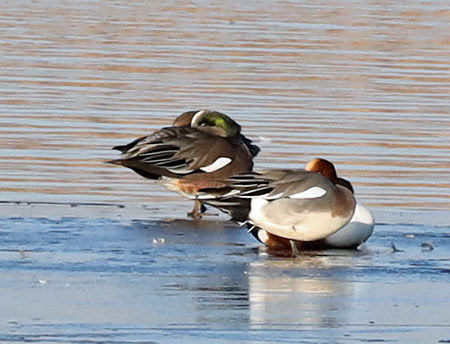
We arrived just before lunch time and headed off to the Noah's Lake hide as this is where we were told both Lesser Scaup and the American Wigeon were to be found.  On route we saw Marsh Harrier, Great White Egret of note. Arriving at the hide we found it almost empty except two guys who had just refound the Lesser Scaup and kindly gave us rough direction of where to look.  After scanning for a few minutes I managed to pickup the scaup a female showing a well defined white saddle over the forehead busy feeding in the company of a few Tufted Duck.  So it was then I started to search for the American Wigeon through the many hundred of Shoveler, Teal and Eurasian Wigeon which were lining the edge of the ice around the only open water, whilst having our lunch.   The two guys left and we were joined by another couple who asked about where to look for the Lesser Scaup so I described to them the area and quickly located it in my scope and gave more precise instruction, then continued my search. It was then as I panned back to where I had stopped searching for the Wigeon a grey sided Tufted Duck like bird popped up. Increasing a scope magnification and zooming in on the bird it showed no crest on the head and the grey sides started at the breast side with a white check like mark.  It took a few minutes before I had a good look at the bill but when I did you could make out the whitish band at the edge of the bill base and the band across the tip of the bill.  I said to Jackie and the others I've got a Ring-necked Duck and directed them onto it so they could confirm I was correct.  The other couple said "oh yes we have it, that's our second, we had one at Blagdon Lake a couple of days ago".
They then left and we continued to scan through the many duck for the wigeon with no luck.  So we thought we would have a look around Hamwall so started our return to the car park.

I suppose we were two thirds the way back and the couple who had left us ten minutes or so earlier were scoping the wildfowl on the Meare Scrape as we joined them they said "we've got the American Wigeon". There it was in a scattered line of mixed duck all tucked up to keep warm in the afternoon sun, not bad, three yank ducks within an hour or so, not an every day occurrence.

American Wigeon with Eurasian Wigeon - Shapwick © Nick Hull

We decided to call it a day and head towards our accommodation at Meare have a restful evening and return in the morning and bird Hamwall.

Next morning we had a heavy frost and everything was white but the sun was coming up and the day had promise. By the time I had defrosted the van and got underway we didn't arrive at Hamwall until around 09:30hrs and joined three other cars in the car park. As soon as I'd unloaded Jackie's scooter we were off.  One of the first species seen was a Great White Egret stood at the edge of the reedbed in the haze socking up the morning sun.

Great White Egret - Hamwall © Nick Hull

Continuing our walk we slowly tick off the the species we had seen all common but all very nice to see.  Marsh Harrier, Chiffchaff, Chaffinch, Goldfinch and Bullfinch, Shoveler, Teal and Wigeon. Robin and Great Tit seemed to be everywhere some would come and beg for food almost landing on you.  We searched through the Alder for Redpoll and Siskin and eventually Jackie spotted a Siskin and looking for it I came across three Lesser Redpoll and at eye level give great views.

Lesser Redpoll - Hamwall © Nick Hull

A little way after I found a very nice approachable male Blackcap eating privet berries.

Blackcap - Hamwall © Nick Hull

We completed our morning at 12:30hrs back at the car park with 50 species under our belt. We headed off for lunch at the Avalon Craft Centre before moving to Catcott and then onto West Hay.  We added very little at Catcott the cold weather had blanketed the area in ice.  The same at West Hay but at least as we approached West Hay we added 11 Cattle Egret to our day list the only addition on the day.

The next morning we headed home via Lyme Regis not the most direct route but it enabled us to add a couple of species to our Dorset list Purple Sandpiper on the harbour Beach and Dipper on the River Lim.

Dipper - Lyme Regis © Nick Hull

Purple Sandpiper - Lyme Regis © Nick Hull

So we ended our trip to Somerset and quick visit to Lyme Regis brought our year list to 102 species with a few more addition to go before Spring is here and the summer migrants are arriving.