About Two Owls

Thursday, 11 May 2023

March/ April Update

March 
I think is always a slow month when you are still trying to get those odd winter species that you haven't seen and towards the end of the month there is that expectant feeling of an early migrant.  The weather was pretty awful and wet which limited birding somewhat and Jackie and I managed to get out and around ten times over the month mostly local around the harbour.

We only managed to add five species to our year list Knot, Greenshank, Red-legged Partridge, Skylark and Spotted Redshank.  We also had a unexpected sighting though fairly brief of a male Cirl Bunting at the Sheeps Pen car park at Encombe, Isle of Purbeck, which has to be the highlight of the month.

So our year list stands at 132 species which I think is pretty average but as we don't twitch very much these days only really going for lifers trying to reduce our carbon footprint, I don't thinks we are doing too badly.  The photograph below is from our archive just in case you can't remember what one looks like.

male Cirl Bunting taken in Normandie © Nick Hull

April
April in contrast to March couldn't have been more different with something like 32 new species for the year list though not all in Dorset.  As at the beginning of the month Jackie and I had a few days down on the Somerset Levels as I wanted to try and sound record Bittern.  

We started our birding on the levels at Greylake RSPB reserve to see if we could find a Garganey which was reported to be there.  Well it was and we saw it almost as soon as we looked out of the hide and it wasn't too far away.

Male Garganey having a wing stretch - Greylake RSPB © Nick Hull

We had our only view of Bittern here or rather I did as Jackie didn't get on to it quick enough before it dropped into the reeds out of sight, a pretty good start to a few days away.  We then headed off to Ham Wall and had lunch before walking over to Shapwick Heath. As we were heading up along the channel path we started to hear the booming of Bittern and I started to do a little recording but there was really to much background noise, but none the less I managed some. It also gave me an idea of where I needed to be the next morning.

On the 3rd Jackie and I were up early had breakfast and out in a cool frosty morning and arrived at the Ham Wall car park just after opening heading back to the spot I had been recording the evening before.  We stood in the quiet of the morning and as the birds woke and started to sing therir territorial songs.  I set up the recorder and recorded Blackcap, Cetti's, Willow Warbler, Chiffchaff and Reed Bunting and then we heard a distant boom.  In fact over the next hour or so we pretty sure we had recorded at least five Bittern Booming from the one spot and one was so close it vibrated the parabola dish it was amazing to hear with the headset on.


As people started to arrive I gave up on the recording and we did a little birding from Noah's Lake hide where we added Barnacle Goose to the list.  We heard that two Cranes were showing well at Catcott Lows so we headed off in an attempt to try and see them.  On our arrival we were told they had just flown off a few minutes earlier. So after having a good look around we headed back to Ham Wall and spent the afternoon there. Where we caught up with the long staying Glossy Ibis saw two pairs of Garganey and several Great White Egret, plus all the usual more common species. As we were leaving and nearly back to the car park a flight of Greylag Geese flew in and one was obviously smaller getting on to it, you could see it had a white forehead blaze identifying it as a White-fronted Goose.  We spent the last part of the day at West Hay where we listened to Bittern booming and lots of Swallow and Sand Martin feeding over the reed beds and recorded our first Reed Warbler of the year. As we headed back to Meare where we were staying I made a wrong turn and we drove around in a bit of a circler route to get back onto the correct road. Which turned out to be very fortunate as we came across a Barn Owl which gave good views as it quartered over the fields.

Back home our next outing was to Blashford to catchup with the female Scaup which we just managed at the last minute just before we were to leave, thanks to Lorne Bissell. We also added Little Ringed Plover on the edge of Ibsley Water.  

On the 8th of May Jackie and I were on domestic duties when Jackie called something is upsetting the Herring Gulls then she shouted "Osprey" I shot out with the camera and managed a few shots as it soared over the garden carrying a fish before it headed off northward.

The gull warning system & Osprey © Nick Hull

Same Osprey with fish © Nick Hull

That afternoon we had a drive up around the Cranborne Chase and stopped off at Wyke Down where I managed to see a male Hen Harrier but failed to get Jackie onto it in time before it disappeared over the ridge.

It was another eight days before we managed to get out to Lodmoor with friends and had a pretty good day adding Common Sandpiper, Sandwich Tern, Grasshopper and Reed Warbler and a stunning male Pied Flycatcher.

Male Pied Flycatcher - Lodmoor RSPB © Nick Hull

The next day (17th) Jackie and I did our Osprey watch and managed to add Woodlark and Mistle Thrush to our 10km list and on the way home I noticed lots of gulls feeding in with the cattle by the Post Green road. So we stopped and had a brief view and found over 50 Mediterranean Gull and 3 Wheatear in the field which were also added to our 10km checklist.

On the 21st Jackie and I had a second try for the Night Heron that had been seen by the Stour at IFord, Christchurch, We had dipped on the previous visit as the birds were flushed by a dog walking along the north bank.  Well we arrived and walked the 120m or so up river from the bridge and there sat on a branch over the river was one of the three Night Heron that had been present in the area for about a week.

Night Heron River Stour Iford © Nick Hull

Over the next eight days we had a run of good birds we started just with our first Whimbrel in Lytchett Bay on 23rd that evening a Forster's Tern was seen from the new Rock Lea view point but next day it was back in the bay and Jackie and I managed to see it distantly at first from Footpath 12 before moving to the Lytchett Bay view point where we had good scope and bins view of this rare American tern. It was still a little distant to photograph but I managed a few passable memory shots of this second for Dorset.  The first was at Ferrybridge in 1996 which we also saw.
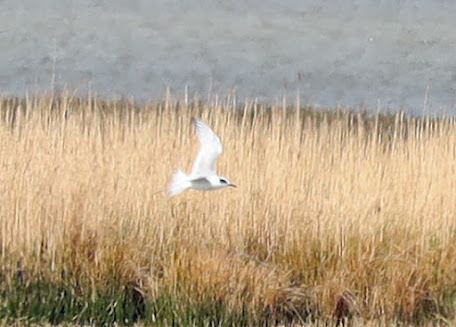
1st/winter Forster's Tern - Lytchett Bay © Nick Hull 

On the 25th we had arranged with a friend to visit Durlston CP. to go and find some orchids and catch up on a few sea going species absent from our lists.  We added three before lunch Guillemot, Razorbill, Fulmar, whilst we were thinking of going for lunch a message came through to say there had been a Woodchat Shrike found at Herston, Swanage so once we had replenished ourselves with food and drink we headed off to see if we could find it.  After sorting out where we had to be, we eventually found it sat in a some gorse and bramble scrub where it gave us good views.

Woodchat Shrike - Herston © Nick Hull

But the month hadn't ended nor had the good birds as on the 29th a Dotterel was found between Renscombe Farm and St Adhelm's Head just as Jackie and I was leaving the house on our way to see if the Black-winged Stilts were still on Lodmoor.  So fortunately we changed plans and headed to Purbeck.  Around forty minutes later we were stood watching a distant Dotterel and a couple of accompanying Golden Plover on a recently cultivated field we also saw two Wheatear as well. 

Female Dotterel - Renscombe © Nick Hull

Which as it happened it saved us wasting a journey to Weymouth as the Black-winged Stilts had left left.  We ended the day by adding Yellowhammer to our year list at Wild Woodbury on the way home. Bringing our total for the month to 121 species and 164 for the year. With plenty to still connect with.

Tuesday, 7 March 2023

February 2023 Roundup

January finished with a credible 114 species on our list though a handful of these were not local or in the county but according to my BirdTrack summary I entered 602 records and completed 34 lists from 36 location.  With highlight of three American rarities at Ham Wall it wasn't a bad start to the year's birding, but would February be as good?

We began February with a visit to Acres Down in the New Forest joined by friends. It was cold and overcast and it wasn't a great morning for birding but we persisted with very little gain although we managed to add Stock Dove and bird of the morning was two super Firecrest.  In the afternoon Jackie and I went on to Hurst Spit to try for the Shorelark unfortunately as we were walking out towards where the bird was being viewed a dog walker walked along the shoreline and flushed it out into the marsh and we missed it, though I doubt it will be our last dip of the year.  So overall not a memorable day.

pair Stock Dove - New Forest 

We were back on the 10km patch on the 5th Feb and spent a couple of hours around Middlebere adding Dartford Warbler to our list. Next day it was birding on the Lytchett patch whilst doing a little volunteering at the same time.  My little bit of litter picking and trimming back of gorse and brambles overhanging the footpath was to be rewarded with sightings of Red Kite and White-tailed Eagle. The same night, just as I was off to bed, the Tawny Owl called from the wood across the road  which made a nice end to the day.

On the 14th we managed to add Barn Owl to the 10km patch, which is a very good bird as there aren't many pairs that can be found in the harbour area now.  Our next outing was with friends to Radipole Lake RSPB adding our first Cetti's Warbler and for me only Bearded Tit fortunately I just happened to be looking in the right place when two flew across a gap in the reed bed calling and disappeared straight away.

Drake Pochard photographed at Radipole Lake  Nick Hull

We added Yellow-legged Gull at Longham Lakes on the 21st and had what must be our largest flock of Pochard we have seen in a few years of 118 mostly males.  It's odd that this species has declined as a wintering visitor to East Dorset once Little Sea and Poole Park would see large numbers in winter but sadly not the case anymore. Looking back over the years Poole Harbour counts would be around 350 wintering birds annually.  The most recent report states the peak counts in Dorset were 500 on the Fleet & Wey combined, 60 for Longham and 21 for Silverlake.
The Poole Harbour record for Pochard was in February 1963 when 2,801 were counted in Poole Harbour as a whole.

On the 22nd just after having a late lunch we received a message from Shaun Robson to inform us that there was two Common Crane soaring over Lytchett Minster so we quickly grabbed our bins and we were off heading towards the the Upton Flyover when we received a second message to say they were drifting towards Lytchett Fields.  So we headed to the bottom of Slough Lane and quickly jumped out of the car and started scanning the sky over the fields.  I quickly picked them up as they drifted towards the south and disappeared out of sight.

On the 24th I was up early and out to Holton Lee on a Woodlark Survey unfortunately it was a little cold for ideal conditions but none-the-less we walked the heathland areas but no Woodlark were found or heard but there is still time. The only consolation was I heard Green Woodpecker which is getting harder to find around the Lytchett Bay area these days.  

After getting home and joining Jackie for breakfast we headed off to Studland to see if we could find the reported Velvet Scoter out in the bay but another dip but we did see the 'Studland Three' Ring-necked Parakeets noisily flying around near the Pig by the Beach Hotel.

Rose-ringed Parakeet (The Studland Three) 

We ended the month back at Acres Down with our two Godsons who have recently gotten into birding.  They particularly wanted Lesser Spotted Woodpecker and Hawfinch.  We tried for the lesser spot first but only had it drumming distantly but we had brief views of two Crossbill flying over.  Moving up to the raptor view point it soon became obvious it wasn't the weather for birds of prey. In fact there wasn't a buzzard to be seen let alone anything else. We went to over towards the east and here we had some luck 4 Hawfinch flew in and perched up on the top a Silver Birch and I managed to get one of them in the scope and had good views.  As we started back to the cars I caught sight of a flock of approx 25 birds flying in and as they crossed our path I realised they were also Hawfinch but they didn't stop.

We had lunch at Eyeworth Pond in the hope of seeing Mandarin but couldn't find them but had good views of Marsh Tit which were year ticks for us and lifers for Nat and Frank, so a good end to the mornings birding.

Blue Tit and Marsh Tit - Eyeworth Pond © Nick Hull

So by the end of February we stand at 127 species from 1004 records having visited  51 location. So we added 13 species to our year list in February.

What will March bring first Sand Martin, Osprey, Wheatear and towards the end on the month Tree Pipit and perhaps an early Redstart.

Wednesday, 8 February 2023

2022 come to an End & 2023 Begins Slowly

End of 2022 and Beginning of 2023

Jackie and I started the month with the hope of catching up on a few missing species, but and yes there is always a but Jackie and I picked up what is now known as the 'Not Covid Cough' virus which put us out of action for just over two weeks. Towards the end when we thought we were recovering Jackie had a coughing fit which ended with her going to hospital for an X-ray on her back and found she had fractured a vertebrae in her lower back so birding was out of the question until she recovered. Though at writing Jackie is improving and we managed to get a little birding on New Years Day to get 2023 off to start 

So over month (December) only 26 species and only two added to the Poole Harbour and 10Km list they were Jack Snipe and Woodcock thanks to Birds of Poole Harbour ringing project. 

Jack Snipe & Common Snipe © Nick Hull

Our next outing was on the 1st January where we birded locally and mainly from the van as Jackie couldn't walk much at all.  So not to test Jackie to much and the fact the weather wasn't good either, we did a couple of hours around Poole and Upton and ended with 44 species not bad for the time spent.  

Next day the weather was much better so we ventured to Portland and Reap Lane to see if we could seen the Cirl Bunting Which we did and had good views of but unfortunately for me I only managed a memory shot of it in the top of a Bramble Bush with its back to me before it flew off further away.  We left Weymouth and Portland area with just 36 species after visiting 6 locations adding just 16 species bringing us to a round 60 in 5 hours of  birding. So we continued birding locally until the 22nd January only doing an hour or two each time we went out not to put too much pressure on Jackie's back. We still hadn't broken the 100 species a figure we would usually get to in the first ten days of the year.  Though considering all the wet weather we were having and then the hard frosts started it didn't make birding a joy.  So with the weather forecast promising to be better from the 22nd we booked a couple of day away in Somerset to visit the levels and to see if we could catchup with a couple of long staying American ducks which were being seen regularly.  So on the 23rd we traveled down to Shapwick and Hamwall.  
Great White Egret - Shapwick Somerset © Nick Hull

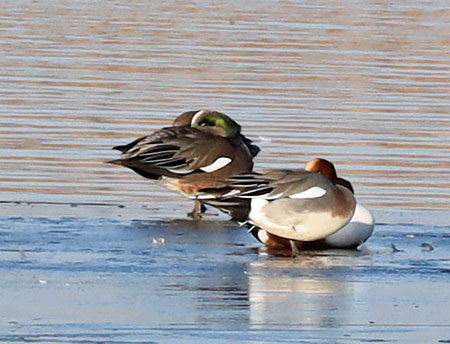
We arrived just before lunch time and headed off to the Noah's Lake hide as this is where we were told both Lesser Scaup and the American Wigeon were to be found.  On route we saw Marsh Harrier, Great White Egret of note. Arriving at the hide we found it almost empty except two guys who had just refound the Lesser Scaup and kindly gave us rough direction of where to look.  After scanning for a few minutes I managed to pickup the scaup a female showing a well defined white saddle over the forehead busy feeding in the company of a few Tufted Duck.  So it was then I started to search for the American Wigeon through the many hundred of Shoveler, Teal and Eurasian Wigeon which were lining the edge of the ice around the only open water, whilst having our lunch.   The two guys left and we were joined by another couple who asked about where to look for the Lesser Scaup so I described to them the area and quickly located it in my scope and gave more precise instruction, then continued my search. It was then as I panned back to where I had stopped searching for the Wigeon a grey sided Tufted Duck like bird popped up. Increasing a scope magnification and zooming in on the bird it showed no crest on the head and the grey sides started at the breast side with a white check like mark.  It took a few minutes before I had a good look at the bill but when I did you could make out the whitish band at the edge of the bill base and the band across the tip of the bill.  I said to Jackie and the others I've got a Ring-necked Duck and directed them onto it so they could confirm I was correct.  The other couple said "oh yes we have it, that's our second, we had one at Blagdon Lake a couple of days ago".
They then left and we continued to scan through the many duck for the wigeon with no luck.  So we thought we would have a look around Hamwall so started our return to the car park.

I suppose we were two thirds the way back and the couple who had left us ten minutes or so earlier were scoping the wildfowl on the Meare Scrape as we joined them they said "we've got the American Wigeon". There it was in a scattered line of mixed duck all tucked up to keep warm in the afternoon sun, not bad, three yank ducks within an hour or so, not an every day occurrence.

American Wigeon with Eurasian Wigeon - Shapwick © Nick Hull

We decided to call it a day and head towards our accommodation at Meare have a restful evening and return in the morning and bird Hamwall.

Next morning we had a heavy frost and everything was white but the sun was coming up and the day had promise. By the time I had defrosted the van and got underway we didn't arrive at Hamwall until around 09:30hrs and joined three other cars in the car park. As soon as I'd unloaded Jackie's scooter we were off.  One of the first species seen was a Great White Egret stood at the edge of the reedbed in the haze socking up the morning sun.

Great White Egret - Hamwall © Nick Hull

Continuing our walk we slowly tick off the the species we had seen all common but all very nice to see.  Marsh Harrier, Chiffchaff, Chaffinch, Goldfinch and Bullfinch, Shoveler, Teal and Wigeon. Robin and Great Tit seemed to be everywhere some would come and beg for food almost landing on you.  We searched through the Alder for Redpoll and Siskin and eventually Jackie spotted a Siskin and looking for it I came across three Lesser Redpoll and at eye level give great views.

Lesser Redpoll - Hamwall © Nick Hull

A little way after I found a very nice approachable male Blackcap eating privet berries.

Blackcap - Hamwall © Nick Hull

We completed our morning at 12:30hrs back at the car park with 50 species under our belt. We headed off for lunch at the Avalon Craft Centre before moving to Catcott and then onto West Hay.  We added very little at Catcott the cold weather had blanketed the area in ice.  The same at West Hay but at least as we approached West Hay we added 11 Cattle Egret to our day list the only addition on the day.

The next morning we headed home via Lyme Regis not the most direct route but it enabled us to add a couple of species to our Dorset list Purple Sandpiper on the harbour Beach and Dipper on the River Lim.

Dipper - Lyme Regis © Nick Hull

Purple Sandpiper - Lyme Regis © Nick Hull

So we ended our trip to Somerset and quick visit to Lyme Regis brought our year list to 102 species with a few more addition to go before Spring is here and the summer migrants are arriving.

Sunday, 11 December 2022

November Birding

After our Normandie trip it was back home to wet stormy weather so the start of the month was pretty slow mainly patch birding, ticking off the usual waders and woodland birds and those visiting the garden feeders.  On the 11th it was a clear sunny day though a little windy and Jackie wasn't feeling a 100% so I went out to Studland on  my own to see if I could get a few photographs of the Snow Bunting which had been found on the beach at Shell Bay. Annoyingly the Corfe Castle to Studland road was closed so I had to go via Swanage.  After arriving in the NT car park by the ferry toll booths I headed off out on to the beach and fortunately due to the ferry being out of commission on its service there were very few people on the beach.  I had been told that the bunting was often near the new enclosure so I wondered up the tideline near the sand dunes thinking if it was anywhere it would be searching for food in this area.  Well I scoured the area with no luck and I was just going to give up when I heard a Snow Bunting call going overhead but looking up didn't see it pass over me.  I scanned down the beach and saw fellow birder Gary Hayman walking towards me it didn't look that he had seen it either so I decided to walk through the dunes and marram incase it had pitched down into cover. I kept an eye on Gary as he walked toward me and I then noticed he turned and was looking at something on the beach and guessed it was the bunting so I quickly joined him and another birder and there it was just a few metres away and it enabled me to get some nice shots of this arctic breeding bunting.  
Snow Bunting - Shell Bay © Nick Hull

After we had our fill of Snow Bunting Gary and I then walked out to Jerry's Point to look over the harbour.  This proved quite fruitful as we had 2 Red-throated Diver, 3 Great Northern Diver, and Black-necked Grebe and my first Red-breasted Mergansers of the winter.  At the end of the day Jackie and I recieved news that there was a Great Northern Diver in Lytchett Bay, a patch lifer, so we quickly headed out to Turlin Moor as that was where it had been seen last and in the last light of day we managed to see it roosting on the water in the main channel.  We popped out again on the 13th and had better views of it just off the Turlin screen, not often we add a species to our patch life list so thanks goes to David White who found it.

Red-throated Diver - Bramble Bush Bay © Nick Hull

In the late afternoon (13th) we traveled up to the northern chalk around the Cranborne Chase where we managed to have brief views of Grey Partridge, Red Kite and a early evening Barn Owl and a small flock of Corn Bunting going off to roost, not a bad day.

In bad weather on the 15th we had a look around the northern side of the harbour well mostly from the van as it was wet and windy but the only bird of note was a single late Swallow which passed by the van whilst at Baiter.  

On the 17th we headed down to Weymouth via Dorchester where we were to pick up my mother and take her out for lunch.  Once we arrived in Weymouth it was a little early to go straight to lunch so as the Sabine's Gulls were still at Chesil Cove, we had missed them on our last try, we popped over to Portland and had a look.  As there wasn't a parking space I had to to the top of the road to turn the van around. At the top we had the height to look over the wall to see over the Cove and there right in front of us were two Sabine's Gull. I jumped out of the van with the camera and took a couple of quick shots and then we headed off for lunch at the Turks Head at Chickerell and very nice it was to.

Sabine's Gull - Chesil Cove © Nick Hull

Sabine's Gull - Chesil Cove © Nick Hull

A shot of a Kittiwake that was in the company of the Sabine's Gull and a couple Black-headed Gull and Herring Gull which was all that could be seen.
Kittiwake - Chesil Cove © Nick Hull

On the 20th Jackie and I met friends for a walk around Lodmoor which turned out pretty non-eventful in that it was more or less the usual species present but a flock of Golden Plover and a redhead Goosander were nice bonus species. In fact I can't remember having seen Goosander before at Lodmoor.
Female Gossander - Lodmoor © Nick Hull

Unfortunately this was the end of our birding for the month as we both came down with a winter chough/cold and spent the remainder of the month trying to shake it off.  So we only managed 90 species this mouth but added one or two to the 10km and 1 patch lifer so not to bad at all.  What will December bring?

Thursday, 8 December 2022

Short Break to Normandie

After Mig-Week in Yorkshire Jackie and I spent a few days at home before we headed off to Normandie as we had to use up our ferry tickets which we purchased back in 2020 for our crossing from Poole to Cherbourg.  We didn't have the best of weather sunshine and showers I think sums it up pretty well.  Though it enabled us to do a couple days of birding and visit friends which we hadn't seen since before covid hit. 

For our first couple of days we stayed at Crasville a small hamlet near the coast which gave us access to drive to a few of our favourite places for birding. Gatteville-Le-Phare, Saint-Vaast-la-Hougue, Domaine De Beauguillot, La Pointe de Brevand, Géfosse-Fontenay and the  
Ponts Douve, Carentan les Marais. We saw 88 species in what was two and a half days of birding not too bad but if the wind was in the right direction we would have picked up more birds off shore but sea watching was poor.  

Cattle Egret - en-route to La Pointe de Brevand © Nick Hull

The Domaine De Beauguillot is a wetland reserve unfortunately they are doing some conservation work on the reserve so a large area was closed off but we managed to scope over part of the reserve.  We found a large flock of Barnacle Geese also Golden Plover in with the Lapwing and what was really nice was we had two Zitting Cisticola 'zitting' around us.  It was nice to see them as they suffered a few years ago when the Beast of the East freeze hit France as well as us in the UK and Zitting Cisticola suffered badly in Normandie as did the Cattle Egret.  In fact around the polder that surrounds the La Baie des Veys we came across really good numbers of Cattle Egret with many of the grazing cattle herds.

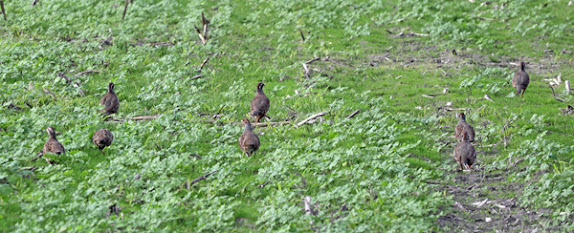
Red-legged & Grey Partridge near La Pointe de Brevand

At>La Pointe de Brevand we had the usual common waders though the tide was out and the waterfowl were scattered over the the mud far and wide. So we headed to >Géfosse-Fontenay en-route I spotted a small covey of partridge of both Red-legged and Grey species which we don't often seen here. Looking out from the beach at >Géfosse-Fontenay the other side of the bay we found 5 Curlew Sandpiper amongst the usual many Dunlin, Ringed Plover, Redshank, Curlew Grey plover etc.  On our return to the cottage I noticed some egret in a field conveniently next to a layby. I quickly pulled in and took a look through the hedge and was surprised to see 9 Great White Egret and a Grey Heron all stood out in the field I assume they may have been migrant birds as I'm not aware of any breeding in the area. That evening at the cottage we heard Cirl Bunting singing in the adjacent field and we also heard it again the next morning.

Female/immature type Black Redstart - Gateville-Le-Phare © Nick Hull

Gateville-Le-Phare didn't produce much, as I mentioned earlier the wing direction wasn't right for good sea-watching, but we had a Peregrine hunting around the Lighthouse (Phare) and saw it catch something presumably a Turnstone or another wader which it carried off east.  We also had a female/immature type Black Redstart around the cottages and a very nice Wheatear with the Alba Wagtails on the rocks by the beach.

Northern Wheatear - Gateville-Le-Phare © Nick Hull

Our only other birding was with a friend in the forest in Calvados where she lives and we added Middle Spotted Woodpecker and Short-toed Treecreeper to our list which was a nice end to a short trip.

Friday, 11 November 2022

October & MigWeek 2022 plus

 MigWeek 2022

Jackie and I have been away to The East Riding Yorkshire for The Flamborough Observatory MigWeek 2022.  This is the fourth time we have visited for this event and there is three reasons for that. 1. Everyone is so welcoming and friendly 2. Some good birding and 3. Excellent lectures. 


From the birding side they have ringing demo’s, vismig every morning, also birding walks and every other evening a lecture. 


We left home on the 7th Oct and arrived around six hours later at a Haven Holiday Park at Flamborough which turned out very convenient for most of the locations we wanted to visit. 


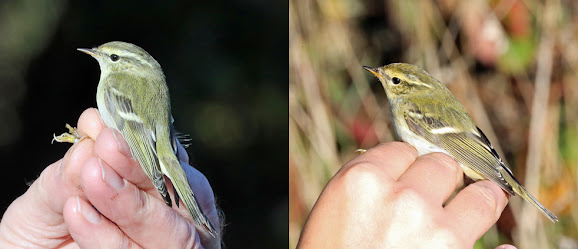
Our first morning we headed to Flamborough Obs at the South Landing to the ringing demo, not expecting a great morning as the wind was in the southwest where it stayed all week which effectively totally wrong for good migration for this coastline.  Nonetheless we were hopeful.  When we arrived the ringing team had just arrived back from a net round with several full bags.  By the end of the the morning had seen two Yellow-browed Warbler, Redwing, Blackcap several Wren, a couple of Treecreeper and Tree Sparrows. They also caught 13 Long-tailed Tit and as they release them all together so they don’t lose contact when they did it was like a bomb burst with birds going in all directions.  


Two of several Yellow-browed Warbler seen Flamborough Obs. © Nick Hull

Looking at the photographs of the two Yellow-browed Warbler the plumage colour difference is probably due to different light condition when the shots were taken but you can see the bill colour differs with the one pictured on the left having an orangey lower mandible.

Just as the morning ringing had slowed down news of a Bittern at Thornwick Pools came through, this was literally right next to where we were staying so we headed off and ten minutes later were in the hide viewing across the pools.  Within a couple of minutes the Bittern walked out of the small reed bed and up the bank opposite pointed its bill skyward and enjoying the warmth of the sun.  I wish all twitches were as easy as this. 


Bittern- Thornwick Pools © Nick Hull

Most mornings we would start the day at Flamborough Obs with the ringing and gauge what to do next on the amount of overnight migration there had been.  Due to the wind direction most mornings were a little slow so we would head off somewhere else one such place was Hornsea Mere.  The Mere can be very good and has aways turned up something on our previous visits.  This year we arrived and things looked pretty quiet but we met a local birder intently scanning through distant wildfowl and he told us he had seen a Black-necked Grebe and a drake Greater Scaup in with the many Wigeon.  So we joined him and after a while I managed to find the Scaup an immature male or perhaps one still in partial eclipse plumage and a short while later found the grebe.  Whilst we were there the wildfowl numbers continued to increase as birds were flighting into the Mere and whilst directing another couple of birders towards where the Scaup was in the growing raft of duck four Whooper Swan flew in and settled giving there typical 'hooping' calls. 


On another occasion we headed off inland to Top Hill Low this is a water treatment works reservoir. Our target species here was to find a Smew on the reservoir.  Since we last visited here with a Two Owls group there had been a new hide/welcome centre built which was very nice but unfortunately not all the trails were open due to maintenance work. From the main hide we scanned the reservoir which had a good selection of wildfowl present with Wigeon, Shoveler, Teal, Tufted Duck, Pochard and of course Mallard also there were seven Whooper Swan.  


Whooper Swan - Tophill Low © Nick Hull


We found a Black-necked Grebe just left of the hide much closer than the one we saw at Hornsea.  We continued our scanning and eventually another birder said he had found the Smew roughly half way along the reservoir with a few Coot and Tufted Duck.  It was a nice red-headed female and she was busy diving regularly and would regularly disappear.  We also found Goldeneye in fact around ten birds were on the water here, a species which was hard to find in the harbour at Poole last year.  We also visited again the next day with friends and went to a different hide over looking a large pool with islands and here we had Green Sandpiper, Ruff, Curlew, Redshank, Little Grebe, Greylag Geese a single Pink-footed Goose and a small flock of Golden Plover, which added to our growing list.


Reeve & Ruff - Tophill Low © Nick Hull

We also came across a few insects this very fresh Comma was a nice addition.


Comma Butterfly - Tophill Low © Nick Hull

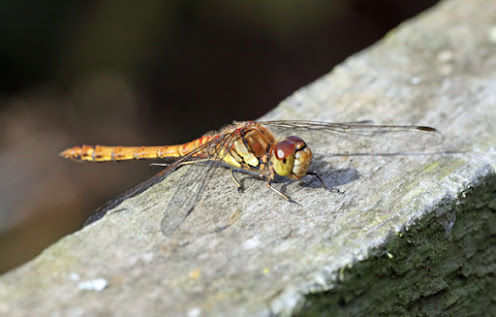
and we also found several Common Darter one or two were seen still matting.  You can see the white stripe on the legs in this shot which is a good id feature for this species.

Common Darter - Tophill Low © Nick Hull

On two other mornings we were up early and went to Hunmanby Gap this was where Keith Clarkson was taking an introduction to vismig for anyone who wanted to join him.  We were also told it was good in a southwesterly wind.  On our first visit on the12th October it was pretty mediocre with small numbers of Goldfinch, Linnet, Siskin, Chaffinch, Skylark Reed Bunting, and unlike home small numbers of wildfowl passage with Teal, Mallard, Wigeon, Greylag Goose and by far the largest numbers of the morning around 260 Pink-footed Geese.  Apparently not all are going further south to Norfolk for two reasons one is that the farming practices have changed and there isn’t so much sugar beet being grown in Norfolk and the second is believed to be due to the milder climate and the geese are short stopping in Yorkshire, roosting on the Humber and flying north into the fields to feed during the day.

Flight of Pink-footed Geese - Hunmanby Gap © Nick Hull


Our second visit was on the 16th and was much more productive in variety of species and we had an increase in numbers of most species compared to on the 12th. We added a number of species not seen on the previous visit such as Golden Plover a Great White Egret, House Martin, Song Thrush and Redwing, tree Sparrow, Rock Pipit, Lesser Redpoll and Yellowhammer.  


Though Jackie and I are pretty experienced birders and vismig-ers we both learnt something from Keith’s vast experience watching from the site and little tips he passed on how to identify some of the species passing over.  Keith must be one of the most enthusiastic birders I have met and it was a joy to spend a few hours in his company at Hunmanby Gap. 


Looking back on this years Migweek the best bird this year must fall to the Barred Warbler which we saw on the 10th.  We had visited Bempton and Hornsea in the morning and as it was quiet on the bird front we went into Bridlington to a little food shopping and fuel up the van.  On the way back to the campsite news came on  WhatsApp that a Barred Warbler had been found in the brambles near the Fog Station on Flamborough Head, so off we went.


Barred Warbler- Flamborough Head 

When we arrive there were half dozen or so birders looking into the bramble patch opposite the cafe so we joined them and were given direction by a birder and quickly found the birds sat in the sun amongst the brambles.  After a few minutes it began to move around and over the next ten minutes or so we gained excellent views of this large immature sylvia warbler.  


Siskin, Barn owl, Treecreeper & Bullfinch © Nick Hull

Friday, 30 September 2022

September - finding White-winged Tern and more

Evie my 12yr old granddaughter has been volunteering along with me at Arne through the summer holidays and on the 1st we were doing reptile work placing out new covers and removing old ones etc. During the morning we had a view of one of the White-tailed Eagles and Stewart suggested we had lunch at the old Clay pit lake and as we were munching lunch Terry called Osprey and there it was crossing in front of us and it perched in a dead tree across the lake and stayed until we finished our lunch when it flew around and headed out over the Wareham Channel. Not often you can say you had lunch with an Osprey.

Osprey Arne © Nick Hull

Getting back into the swing of birding and our first highlight was 3 Curlew Sandpiper in Brand's Bay thanks to a call from @StudlandBirder on the 4th Sept we then followed this with ticking them off on the Lytchett Patch on the 10th when we also added Whinchat. 

Curlew Sandpiper & single Dunlin © Nick Hull

On the 9th we tried twitching a Bee-eater btween Woolgarston and Harman Cross but dipped though managed to add Redstart to the 10km list and also saw a couple of Spotted Flycatcher which is always nice to see and a juvenile Marsh Harrier which drifted over the Purbeck ridge and continued towards Corfe Castle.

Common Redstart - Woolgarston © Nick Hull

The absolute highlight of the month was on the 11th when we id'ed the White-winged Black Tern or White-winged Tern which some authorities now call it. Jackie and I heard that there were two Black Terns at Longham Lakes and thought we would go and check them off for the year list.  On our arrival we spotted them straight away at the far end of the North Lake and made our way around the lake to gain closer views.  

We had been watching them for sometime and I'd taken a few photographs when I spotted another tern flying in over the causeway and join the others.  I first thought it was another Black Tern but after getting better closer views realised it looked different it was obviously paler in colour and even looked a tad smaller.  Then I noticed it had a white rump and pale tail and mentioned it to Jackie she agreed and I said I think that is a feature of White-winged.  So we started to take more notice at this point George Green walked around the corner and said hello you two have you noticed that other tern and we affirmed our suspicion of what we thought it was.  He replied I was thinking the same.  So over the next half hour we managed to see all the features that we felt proved it was a White-winged Tern.  When a local photographer Jeremy McClements walked around the corner and I asked him if he had any shots of the pale looking tern, he scrolled through his shots and said "yes I think so here" showing me the back of his camera and George and I agreed the photograph proved without doubt it was a White-winged Black Tern and we put the news out for others.  I went back the next day to get some more shots of it as the ones I took at the time didn't really pass muster which I managed to do also managed to take a few shots of a Black-necked Grebe that had turned up overnight.

White-winged Tern Longham Lakes © Nick Hull

White-winged Tern Longham Lakes © Nick Hull

On the 15th we were invited on a harbour boat trip up the Wareham Channel leaving Poole Quay at 17:00hrs it was a pretty good trip We saw one of the White-tailed Eagles and watched a Green and a Wood Sandpiper on the Stilt Pools on Wareham Meadows take flight over the boat and you could see the Green Sandpiper was a much stockier and bigger bird as they flew past and away.  We also had seven Cattle Egret go into roost on the Island on Swineham Gravel Pits.

We twitched Lodmoor of the 16th as there was a punitive Citrine Wagtail which had been found by @MadDog the day or two before but it was a little oddly plumaged but none-the-less we decided it was best to go and see it. It turned out to be an easy twitch we arrived at the viewing point and there it was right in front of us with a few Pied/White Wagtails and a couple of nicely plumaged Yellow Wagtail all feeding over a patch of Glasswort.  At one point it was disturbed and all the wagtails flew and moved away a short distance and we heard it call which seemed Citrine like but it really needed to be recorded which it was a couple of days later and it has been confirmed from its calls to be a Citrine Wagtail which will be if accepted as such would be our first in Dorset.

Citrine Wagtail - Lodmoor © Nick Hull

Out on another boat in the harbour on the 22nd I managed to add Ruff to the 10km list but little else could be added which was new. Though we had nice views of Yellow-legged Gull, Hobby and the usual Brownsea Lagoon birds such as Avocet and Spoobill etc.

It was back to Lodmoor on the 25th for a juvenile Red-backed Shrike which had taken up residence on the old landfill site. It performed relatively well for us before it disappeared into the bushes out of sight.  Though at the time of writing it is still present.

Juvenile Red-backed Shrike Lodmoor RSPB

Next day Jackie and I went to Titchfield Haven on the Solent in Hampshire to meet up with Renee a friend we hadn't seen since before the 2020 lockdown. We had a pretty good day as soon as we started we saw four Glossy Ibis on the river and from the hide had an assortment of common species of waders and waterfowl including 3 Curlew Sandpiper right in front of the hide and we finished the day with two flyover Red Kite.  


Glossy Ibis Titchfield Haven © Nick Hull

Glossy Ibis Titchfield Haven © Nick Hull

This month has brought our year total to 208 species but we really need to get a good seawatch and some VisMig in at sometime before it's too late.

As for other wildlife in September we came across a few Small Copper one of which was in the Arne Cafe garden. Also I found a stunning Raft Spider Dolomedes fimbriatus on one of the ponds which allowed me to photograph her. I really like the shadow in the water it kinds of adds something to the shot. This species along with Fen Spider in East Anglia is Britain largest arachnid.

Raft Spider Dolomedes fimbriatus © Nick Hull

Small Copper - Arne RSPB © Nick Hull

After which I took Jackie to Middlebere to see the Marsh Gentian which seem to have had a very good year.
Marsh Gentian Middlebere Heath © Nick Hull

The home wildlife garden produced another first for us when our Grandson, Ben, spotted a small caterpillar  on the lavender.  When I went to investigate I also found a small beetle and it turned out too be a Rosemary Beetle Chrysolina americana. Though strangely these beetles are not found in America. It's believed when named in the 18th century by Carl Linnaeus mistakenly assumed the specimens had come from America. In fact they are native to the Mediterranean region of South Europe, North Africa and Middle East.  They arrived in shipments of herbs and first found in Cheshire in 1963 then three more discovered in Surrey in 1994 and since spread across the UK.
 

Rosemary Beetle Chrysolina americana © Nick Hull

Rosemary Beetle Chrysolina americana © Nick Hull

It has I think been a bad year for Odonata as we have recorded nowhere near the usual numbers but it seems that Migrant Hawker Aeshna mixta have done a little better as we have been seeing the odd one in the garden and around Lytchett Bay.

Migrant Hawker Aeshna mixta © Nick Hull

I took a close up of the head and thorax mainly to capture the eyes and face to show the colours and that snazzy moustache 

Migrant Hawker Aeshna mixta © Nick Hull