About Two Owls

Monday, 28 August 2023

Tour de France Part 2 The Dordogne

We were up fairly early, breakfasted, packed the van and headed off across the Gironde vineyards towards the Auberge de Castel Merle at Serseac in the Dordogne. This would be a new department for us so we didn't really know what to expect other than what friends have told us, that it was a beautiful area to visit. We travelled from what you could describe as flat arid dry marsh landscape to a lush green forested, deep river valleys with picturesque villages many with a medieval looking architecture.  

After we arrived in the Dordogne we had a little time before we could check-in to our hotel so we had a little explore locally and parked in a lay-by at the edge of a forest and found a number of species of butterfly and a Wall Lizard.  We also came across a single Pyramidal Orchid on the road verge.

Pearly Heath & Large Skipper © Nick Hull

Female Wall Lizard  © Nick Hull

Pyrimidal Orchid © Nick Hull

Our hotel was 300 years old and started as a farm house and later developed into a hotel and was still owned by the same family and they believe there had been a building there since Roman times.  It was situated on a promontory high above the Vézère River. 

This is the view of the hotel on are arrival.

Hotel de Castel Merle, Sereac Dordogne

We were allocated the Garden room which is through the door on the right of this photograph.

View of our room there is an entrance hall to the right out of view.

This is the view from the door of our room looking across the large patio area with the two pavilions where we had breakfast in the mornings

View from the door of our room

This is the view looking down over the river Vézère from the patio promontory below.

Looking down from the hotel patio over the Vézère River 

I'm not sure how high up we were but possibly 200m above the river but the steep rocky cliffs provided a nesting site for a pair of Peregrine whose young had just fledged and they were often screaming and chasing around very close and sometimes landing in the trees that were on the patio.  There were several pairs of Golden Oriole and one morning while recording the dawn chorus I ended up recording a territorial dispute between two pairs right over the patio area.  The screeching cat like calls would of woken the dead, though Jackie slept through it even when I tried to wake her.  In fact more or less everywhere we went near the river we recorded Golden Oriole though I never managed to get a shot of one they always seemed to hide behind leaves or a branch.

One morning whilst I was waiting for Jackie to join me for breakfast a Red Squirrel ran along the fence to get food from the bird feeder as they do.

Phone shot of Red Squirrel going to the feeder.

It was now our eleventh day in France and the plan was to visit a few sites along the valley starting just a mile or so up the road where there was a view point to look across the valley and a woodland trail good for butterflies. In fact it turned out to be very close to the lay-by we stopped at the day before.

View Point

From the view point we had a grand view over the valley and saw several Black Kite and listened to them calling.  Though it is also a place to see eagles none were seen by us whilst we were there.  So we moved across the road onto the woodland trail and didn't walk far when it opened up into a small meadow.  It was a nice warm sheltered spot and butterflies everywhere. We found Adonis Blue, Pearly Heath, Marbled White, Peacock, Red Admirals and Meadow Brown.  Though for us the ones that took our attention was Black-veined White, Heath Fritillary and Woodland Grayling mainly as they are species we don't get at home.

Heath Fratillary © Nick Hull

Woodland Grayling © Nick Hull

A slightly worn Black-veined White

We then moved on to a old stone quarry again for butterflies also for a chance of finding Ocellated Lizard which we failed to find.  Though we did add a few butterflies to our trip list with Essex and Small Skipper, Adonis Blue, Spotted and Heath Fritillary then for us here the more interesting were Great Banded Grayling, Southern White Admiral and Wood White.  We also added a bee-fly species I haven't seen before and a damselfly to the small Odonata we had seen.

The Great Banded Graylings were very flighty and wouldn't settle close for a really good shot so I had to shoot at distance so couldn't get any real definition and detail but you can see what they are.

two shots of Great Banded Graying © Nick Hull

There were plenty of Wood White and again because the was so hot to get one settled for any time to get a shot was next to impossible but managed to get few ok shots 

Wood White © Nick Hull

Whilst searching around the quarry slightly hidden behind a large bolder Jackie found this super Red Helleborine a plant we have only seen once before many years ago.

Red Helleborine © Nick Hull

The last butterfly we found here was this slightly worn Southern White Admiral when they are fresh the colours are stunning but unfortunately this one was a little faded but none-the-less it was another species to add to our holiday list for the Dordogne. 

Southern White Admiral © Nick Hull

Alway interested in the Odonata and came across these damselfly, which our guide gave as Blue Featherleg which I thought was a new species, but it wasn't until we were home that checking the scientific name that I realised it was a name change for White-legged Damselfly.  None the less it was new for us in France.

Blue Featherleg (White-legged Damselfly) © Nick Hull

Another species which was nice to find here in the quarry was Dune Villa a Bee-fly a pretty scarce species in the UK and the second time I've recorded one in France. 

Dune Villa © Nick Hull
We spent some time here trying to see the lizard but eventually we decided to move on to our next planned location.  This was right on top of the hills with an amazing almost 360º view and again the guide book said a chance of eagles. Here the scubby causse hillside habitat was provided us with some nice views of a number of butterflies many we had already seen but one or two new ones.  

Like this Cleopatra a stunning butterfly which was visiting the Vipers Bluegloss and allowed me to play with the camera settings to get a few acceptable shots.

Underside and upperside of Cleopatra butterfly © Nick Hull

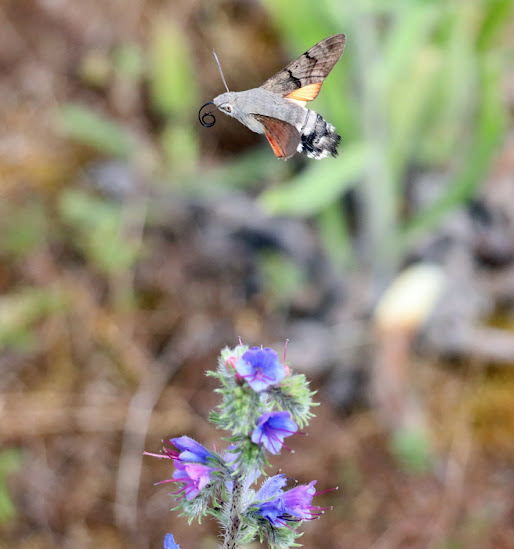
I also managed a few more shots of various Hummingbird Hawk-moths as they zoomed around the Vipers Bluegloss.

Humminbird Hawk-moth manoeuvring  to come in the Vipers Bluegloss © Nick Hull

We decided we had seen most of what was on offer at this site and it was approaching lunch time so we  headed off to lunch. Which turned out to be a bit of an odd experience but that's another story.  As we were getting into the van I picked up movement on the bramble and it turned out to be this Blue-spot Hairstreak.

Blue-spot Hairstreak © Nick Hull

On the 13th we drove along the valley to Limeuil a very picturesque village next to the river where the Vézère River which starts under the ridge to the left and the Dordogne River continues under the bridge on the right.

The twin bridges / viaduct over the Vézère & Dordogne Rivers © Jackie Hull

There was a good House Martin colony under the parapit of the bridge and there were several Swallow also nesting nearby as they were coming into pick up mud from the bank to build their nests.


House Martin coming in to the bank for mud for nest building

Swallow doing the same with one coming and one leaving with mud.

We walked back to the van to cross over the two bridges to continue our planned route, as we neared the van we had close views of a Black Kite that circled over us before drifting off down river.

Black Kite © Nick Hull

Once we had crossed the bridges we stopped on the opposite bank for a brief stop at a slipway for boats to enter the river where we had a few odonata along the river bank.

When I first saw this pair of Western Demoiselle I thought they were Banded it wasn't until I was checking through my photographs I noticed the dark pigmented area extends to the tip of the wing and looking it up in a reference found they were a new species for us in fact possibly one we have overlooked in the past.
Western Demoiselle - male & Female © Nick Hull

This pair below we have seen in the back in Dorset but with the name change in the reference we didn't realise until later but they were very nice to see.
Female & Male Blue Featherleg (White-legged Damselfly) © Nick Hull

This following species I thought was a bright female of the previous species until I noticed the blue eyes so took a few shots of it, which I'm glad I did, as it was another new species for us

Orange Featherleg Platycnemis acutipennis  Nick Hull

Whilst there we also had Azure Bluet once called Azure Damselfly, Black-tailed Skimmer and a new beetle species Blue-violet Chafer an absolute stunning beetle.

Blue-violet Chafer Hoplia coerulea 

Our next stop was just a couple of miles further up the road, we passed through a small wood and exited out into farmland.  As I was looking for a safe place to park up Jackie said whats that hovering over there and I pulled over and took a look, it was a Black-shouldered Kite.  Then I heard a Crested Lark and had a brief view as in pitched in to the grass field to our left.  We walked up the road slowly keeping an eye on the area where it pitched in and it flew up from a totally different place or perhaps another bird  By the time we decided to move on we had see at least three Crested Lark, lots of Corn Bunting, Skylark and a Black Kite.

It's strange when we are in France we take time to have lunch out and theneat light with a glass of wine in the evening.  So we headed into Campagne for lunch and after went to the Chateaux where in our guide book mentioned orchids and Common Redstart was easy to find there.

The Chateaux and lake at Campagne

As we walked into the ground of the Chateaux there was a lake and a small river that fed the lake and lots of odonata Azure Bluet, Blue-tailed Damselfly, Scarce Chaser, Emperor Dragonfly

Common Bluetail (Blue-tailed damselfly) Ischnura elegans © Nick Hull

Blue Chaser (Scarce Chaser) Libellula fulva  © Nick Hull

As we walked around the lake we approached some mature Beech trees and we both heard the song of Common Redstart and it very nicely appeared for us and landed ready to be photographed, what a stunner.

Common Redstart (male) © Nick Hull

Also under the trees here we found more Red Helleborine a fairly scarce plant in the UK and here we've have found them in two different locations in a couple of days.

Red Helleborine © Jackie Hull

Further around the lake I photographed a pair of damselflies in cop, the male having very blue eyes and checking later they were indeed Blue-eye's, which used to be named Goblet-marked Damselfly, another new species for us.

Blue-Eye (Goblet-marked Damselfly) Erythromma lindenii © Nick Hull 

As we were leaving I had a quick shot of this Paper Wasp Polistes dominula a species that is rare in Britain I think only known in a area of Richmond in Surrey.

Paper Wasp Polistes dominula © Nick Hull

As we got back in the car park I spotted a large fritillary fly by in front of the van and land on a buddleia and it turned out it was a Silver-washed Fritillary and new for the holiday.

Silver-washed Fritillary © Nick Hull

This brought another day to an end and it was back to the Castel Merle for our last night in the Dordogne and start our journey home with another brief visit to the Loire before continuing to Normandie for our last few nights before catching the ferry home.

Tuesday, 11 July 2023

June and our Tour de France Part 1

The last week on May and the beginning of June was taken up checking out wildlife for the coming SpringWatch programme and informing the cameramen where we were finding things.  Though for me helping out ended on the 31th May, as I needed to pack as Jackie and I were off to France visiting friends and looking for wildlife.

The plan was to sail from Portsmouth to St. Malo and from there drive down to the Loire overnight then continue down to the Gironde where we would meet friends and explore the local area.  After a week in the Gironde we moved on to the Western Dordogne to the Auberge de Castel-Merle near Sergeac. Staying there for four nights before moving back up to the Loire for a stopover before heading to Normandie for another four nights before catching the Ferry home to Poole from Cherbourg.

Our overnight crossing to St. Malo was uneventful and we were lucky it didn't take long to disembark and to get on our way.  We arrived at our overnight stay Hotel Le Relais du Bellay around midday we checked in and decided to go and visit the Abbaye de Fontevraud just a few miles away. We had visited here many years ago as it was a location for Rock Sparrow.

Abbaye de Fontevraud internet photograph

The first permanent structures were built between 1110 and 1119. The area where the Abbey is located was then part of what is sometimes referred to as the Angevin Empire.  The King of England,  Henry II, his wife, Eleanor of Aquitaine, and their son, King Richard the Lionheart, were all buried here at the end of the 12th century. It was seized and disestablished as a monastery during the French Revolution.


The Abbey is situated in the Loire Valley, a UNESCO World Hertage Site, between Chalonnes-sur-Loire and Sully-sur-Loire within the Loire-Anjou-Touraine French regional natural park (Parc naturel régional Loire-Anjou-Touraine).


The complex of monastic buildings served as a prison from 1804 to 1963. Since 1975, it has hosted a cultural centre, the Centre Culturel de l'Ouest.


We had a good explore around the village and Abbey and we didn't set eyes on a Rock Sparrow though I'm pretty sure at one point I heard one calling but we couldn't locate it. What we did have was several Black Redstart and lots of Swift and a few Swallow which were all very nice to see.


Me watching the Swift come into their nest sites

By the time we arrived back to the hotel we just had time to have a wash and brush up before we had to make our way to the restaurant which Jackie had booked online. It took us a while but we wound our way through the streets down to the restaurant which was next to the river as was our table, giving us a very nice view.


Jackie at the riverside restaurant 


Whilst we were waiting for our meal I noticed near to the edge of the river bank two spikes of Ivy Broomrape.


Ivy Broomrape © Nick Hull


Walking back to our hotel we were walking past the Châteaux when we heard a Eagle Owl and some alarm screechy sounds what seemed to come from a nearby tree in the grounds on investigation it appears it must have been some kind of noisy deterrent perhaps to keep Feral Pigeons away from the building.  


The  Châteaux from where the bird sounds came from © Jackie Hull


The delay was somewhat fortunate as we continued towards our hotel Jackie and I heard a 'Quak' sound high above us, we both looked skyward and two Black-crowned Night Heron were flying over.  We finished our evening listening to a Black Redstart singing from the chimney of the building across the street from our room a really nice way to go to sleep.

Black Redstart


Next morning before we headed for the Gironde and our Gite where we would be staying for the next week. Jackie and I wanted to visit a site just to our south near Loudon where we have had Little Bustard in the past which was only a half hour drive away.  We stopped on the road verge and got out of the van to have a listen and the first sounds heard was the jangling of Corn Bunting then Melodious Warbler followed by Golden Oriole, Turtle Dove and Cirl Bunting.  We continued around the circular route and the only other note worthy birds was Honey Buzzard, Nightingale and Zitting Cisticola but there was no sign of Little Bustard or Stone Curlew. 


Corn Bunting near Loudon

After doing the circuit without any luck we headed for the Gironde where we found ourselves a few hours later.

We soon unpacked and had a look around the garden and the first thing you noticed was the Honeysuckle and it was covered in Hummingbird Hawk Moths zooming everywhere and it was like this everyday we were there, it was fantastic.


Hummingbird Hawk Moth

The Gironde is formed by the juncture or the Garonne & Dordogne rivers and flows into the Bay of Biscay.  The estuary is edged by Maries (marshes) and as you move inland you have the many vin yards that produce Pineau des Charentes a favourite of mine, and the many wines of the Bordeaux region. 

This year they were in the middle of a very dry period having no rain for sometime and the temperature peaked around 30-35ºC most days so birding was carried out in the mornings when is was a little cooler and the birds and wildlife were more active.

The next day our friends, Hazel & Ron, took us inland to a gravel extraction site, we had been there before on a previous visit for Bee-eater but when we arrived at the site it was very busy and we thought best not to go in with all the heavy trucks moving around, plus we couldn't hear or see any Bee-eater.  Anyway Hazel had a backup and just a mile up the road there was another quarry, but as we parked up and got out of the car we could hear the distinctive calls of Bee-eater and it wasn't long before we had located them and getting good views.  

European Bee-eater © Nick Hull

Later the same day we visited a forest site for butterflies.  At this site we added a few butterflies one being pretty scarce and a few day flying moths and a rare damselfly and an orchid. 
First the day flying Moths.

Burnet Companion & Mother Shipton © Nick Hull

5 Spot Burnet & Faust's Burnet © Nick Hull

Butterflies here were few but one of them is fairly scarce and the other was pretty common but not found in the UK.

Pearly Heath & the scarce False Ringlet

We also came across a species of damselfly which was obviously an emerald species but not that of Common Emerald which we find at home so I took a couple of shots and later researched which species a could have been and it turned out to be Scarce Emerald Lestes dryas or Robust Spreadwing.

Male and Female Scarce Emerald Damselfly © Nick Hull

Jackie found this lone Bee Orchid on the grassy verge along the forest ride.

Bee Orchid © Nick Hull

Next day we explored the marshes something we did several times and managed to pick up many of the local species. Such as Black-winged Stilt, Cattle Egret, though usually we see Red-backed Shrike on the marshes but we actually found them in the scrub areas near to the grape vines further inland.


The species that we came across most were Black Kite, Nightingale, Zitting Cisticola, White Stork, Black Redstart and House Sparrows with Red-backed Shrike and Hoopoe also putting in regular appearances. There also still seemed to be good numbers of Turtle Dove in the arable areas. On our travels around the marshes we were taken to an area where a pair of Black-winged Kite are regularly seen and we were lucky enough to find them.  This species has had a rapid expansion in its distribution and is moving up through France very quickly and it wouldn't surprise me if we do not see them here more regularly over the next few years. Our last visit was in 2018 when there were only a couple of pairs this last winter 2022/23 there were 40 in the roost.


Not the best shot of the Black-winged Kite pair but we didn't want to risk disturbing them

We found the Black-winged Stilts in an old salt pan and there were good numbers nesting and a Black Kite came drifting over and all the male birds lifted off and escorted the kite away which enabled me to get several shots like this male flying over and alarm calling.

male Black-winged Stilt © Nick Hull

We came across a number of Cattle Egret this one was with four others accompanying a small herd of Limousin cattle.  As you can see we had a thunder storm hence the wet bedraggled look of this individual. 

Cattle Egret © Nick Hull

In previous visits we found a good number of Red-backed Shrike in the area but this time they seem not so common.. Though we did find birds in and around the vineyards in areas of scrub we also found a few Hoopoe in these areas to.

Male Red-back Shrike © Nick Hull

The White Stork population seems to be doing ok and we came across a number on nesting platforms all of which were occupied.

White Stork platform and stork family © Nick Hull

During our stay in the Gironde we didn't see many mammals though I saw the briefest view of a Pine Martin as it dashed across the road on our way out for mothing one evening and on the marshes we saw Coypu which seems very common throughout Western France. 

Coypu in one of the Marshland Dykes © Nick Hull

Unfortunately we had missed the main orchid flowering period though we did see a few on our travels. 


I had a night out in the forest with Hazel mothing where we managed 72 species, a few were new for me as they are not found in Britain and a few are very rare vagrants to the UK which were good to get experience of just incase one turns up in the trap at home.


The method used by Hazel is a metal frame a bit like a cloths rack which has a white netting stretched over it with two blue UV lamps placed along the top rail and a white sheet placed on the ground under the frame. The method works well and would be ideal for doing a mothing introduction demonstration. 


Hazel checking for micro's on the netting © Nick Hull

We caught six species that were completely new for me which haven't been seen in the UK and one that is found on the Channel Islands which hasn't been recorded on mainland Britain. The following two species are both rarely seen in the UK.


The Passenger & The Latin both rare visitors to the UK © Nick Hull


These following two are micro's which get overlooked by many that go out moth trapping but than can be very nicely marked though my photographs do not do them justice.


Eurodachtha pallicornella & Acrobasis porphyrella © Nick Hull

This one had me confused but it turned out to be a Jersey Emerald but it wasn't green like others I had seen before but it was one that Hazel catches regularly here in the Gironde.


Jersey Emerald found on the Channel Islands but hasn't made mainland Britain yet. 

This last photograph I've put here as I've caught Pale Oak Beauty in the home trap but never Great Oak Beauty and I have always checked the beauty species but will not need to again as when you see the size difference between Willow Beauty and Great Oak Beauty there is no comparison.

Willow Beauty & Great Oak Beauty © Nick Hull

We had a little by catch with the appearance of the super millipede species. It's one of 593 species that are in Europe, compared to 62 in the UK.


This is Cylindromyia bicolor which appears to be thinly spread across Europe.

This is a Lesser Stag Beetle which is relatively common but still nice to see.

We had a couple of mornings when it was a little cooler so we checked out a couple of forest sites for Butterflies and found some nice fritillary species.  I'm not sure but I doubt there is a site in the UK that you could visit and get six species of fritillary along a half mile forest ride.

Weaver's Fritillary & Small Pearl-bordered Fritillary © Nick Hull

Spotted Fritillary & Queen of Spain Fritillary © Nick Hull

High Brown Fritillary & Knapweed Fritillary © Nick Hull

Our week in the Gironde soon came to an end and we had to say goodbye to Ron and Hazel and thank them for showing us such good wildlife around their area it was fantastic and we have only shared a summary of the better species here.  Next we move on to the Dordogne for a short stay before an overnight back in the Loire on our way back north to end with a few days in Normandie all to come in the next Blog.