About Two Owls

Saturday, 28 October 2023

The East Riding of Yorkshire - MigWeek 2023

October is the month that Jackie and I have our annual migration north for MigWeek run by Flamborough Bird Observatory.  The week consists of Bird ringing demonstrations, walks and talks  at Flamborough, Bempton and at Filey, plus VisMig (visual migration watching) at Hunmanby Gap.

So on the 12th October we left Dorset on our way north, but this year we decided to drop in to Frampton Marsh RSPB reserve in Lincolnshire to break the journey. We arrived at around 14:00hrs and spent the rest of the afternoon exploring the reserve.  By the time we left at 17:00hrs we had clocked up 46 species not to bad for a few hours birding.  Highlights were 3 Little Stint, a Jack Snipe, a flight of 8 Whooper Swan, 2 Great White Egret and good numbers of Ruff.
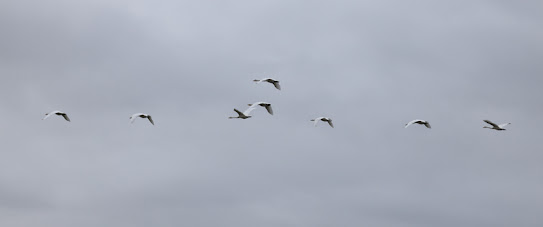
Flight of Whooper Swan _Frampton Marsh RSPB Reserve © Nick Hull

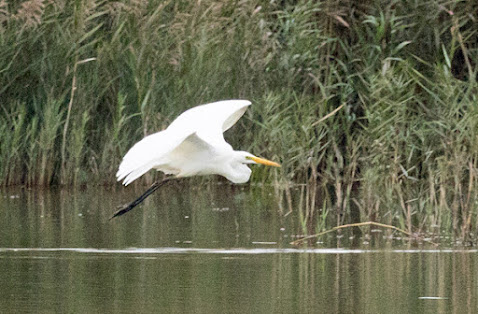
Great White Egret - Frampton Marsh RSPB - coming into land © Nick Hull

We had an overnight stay in Boston leaving in the morning for Flamborough.  We took a break at North Cave nature reserve en-route and whilst having coffee and a very nice burger from the mobile cafe we were able to do a little birding over one of the lakes.  Jackie and I first visited this reserve many years ago when it had first opened but it hasn't changed much but has the added hides and facilities which is always a benefit.  Also it has been landscaped where when we first visited it was a little raw without too much cover. We arrived at Flamborough a hour or so later and decided to have an easy rest of the day so we could  be up early in the morning ready for a days birding. 

14th October - We were at the Flamborough Obs bright and early next morning for the start of MigWeek 2023 and Tony & Jo, Jim and the others of the ringing team were just arriving back to the Obs after doing the first net round with a number of full bags.  They had a nice selection of commoner species, which are always nice to see up close such as Dunnock, Robin, Goldcrest and Blackbird though most of these were possible migrants. In fact the young Blackbird was a certainly a migrant as it's wing length suggested it was northern European and the Scandinavian Blackbirds wing length measures a little longer than our British bred birds. (Remember it's nothing to do with them having black bills that just denotes they are juvenile Blackbirds).
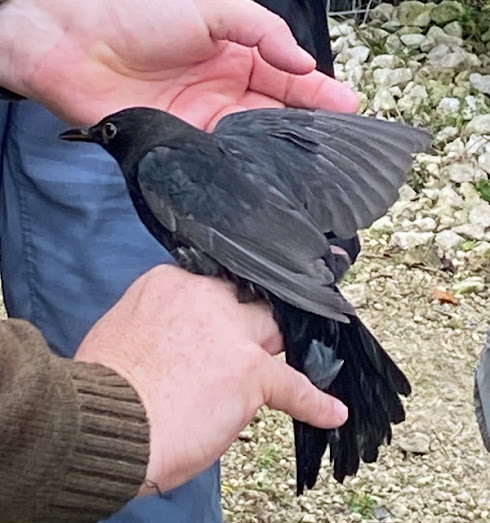
Juvenile Blackbird - Flamborough Obs © Nick Hull
 (This birds wing length suggested it was a migrant from Scandinavia)

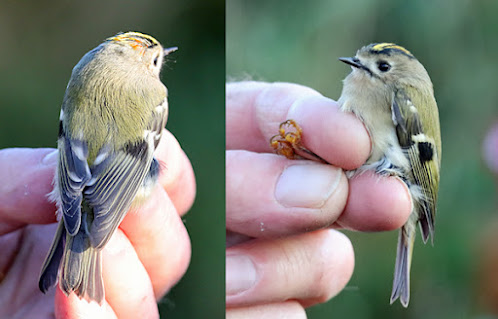
Male Goldcrest - Flamborough Obs © Nick Hull 
(It is sexed as a male by the orange/red feathers showing in the crest)

There wasn't a great deal of visual migration as the wind was in the wrong direction but there was the promise that this would change by the end of the week and to expect another movement across the North Sea.

15th October - Up half an hour earlier this morning to give us time to get to Hunmanby Gap to join Keith Clarkson and Paul for vismig even though the wind wasn't right for migration we hoped for some sea passage. I have to say it wasn't the best morning for the location we only saw 19 species. The highlight was two flocks of Pink-footed Geese moving south which we counted 225 birds.  We also had Red-throated Diver and Common Scoter and a small flock of Lesser Redpoll which were obvious migrants.  We left Hunmanby and headed for Bempton RSPB reserve and had a walk to see if anything was hiding in the dale and around the feeding station. The only birds of note here was a few Redwing and Blackbirds seemed to be in very good numbers around the berry bushes.  After we went back to the mobile home at the campsite for a lazy lunch and warm up before heading back to Bempton in the late afternoon in the hope of seeing Owls hunting over the rough grassland clifftops and fields.

We were indeed lucky in seeing possibly 2 Short-eared Owl and a Barn Owl out hunting, though both were fairly distant for getting a good photograph.

Barn Owl - Bempton Cliff RSPB ©Nick Hull

Short-eared Owl - Bempton RSPB © Nick Hull

16th October -  We started our day at South Landing with the ringing, recording 26 species not all of them were in the hand. It was obvious that it was going to be a slow day so Jackie and I left and headed to Hornsea Mere as there was a Long-tailed Duck there. The Mere can be good and we recorded 31 species including the Long-tailed Duck which I found at the far end of the Mere. Which looked to be a female in more or less summer plumage but it was very hard to assess at the distance we were looking over.  After we grabbed some lunch we headed to the seafront for a little seawatching, the highlight here was several Red-throated Diver and a single Black-throated Diver which isn't that commonly seen here.  We had a flight of Common Scoter flying towards Flamborough and I noticed a slightly smaller bird amongst them and as they came level with us it turned into a male Long-tailed Duck.  We also had two dark-morph Arctic Skua which are always nice to see.  We don't see very much duck passage from Dorset coast so it was a bit odd to see a group of 9 Teal fly-by and pitch down on the sea to rest before continuing on south.

17th October - We were due to meet up with friends at Tophill Low mid morning so we went to the Obs for the ringing first thing before heading off to Tophill Low.  The reserve here is run by the Water authority with ponds, water reservoir and woodland, a lot of work has been done providing new hides and access. There had been Blue-winged Teal and Ring-necked Duck present but we managed not to find either on our visit but there were lots of water fowl present.  Highlights here was 2 Brambling coming into the feeding station and a Black-necked Grebe on the main reservoir and a Migrant Hawker Dragonfly which landed in a tree behind us when we were having lunch.

Male Migrant Hawker Dragonfly _ Tophill Low © Nick Hull

We ended the day at Flamborough Fog Station (Lighthouse) for a seawatch and had a real surprise when a Puffin flew past a species that breeds at Bempton but should have left the area by now.  We had several Grey Seals, Red-throated Diver, Scoter and lots of Gannet, Cormorant and Shags moving.

18th October - Up early to join Keith Clarkson for a vismig session near Bempton but it became obvious that not much was happening through we saw some Redwing and Fieldfare moving though not in big numbers.  So we headed to the South Landing Obs and as we arrived they had just completed a net round and we were lucky to see a male Brambling in the hand.  We then headed out to the clifftop viewpoint for some sea-

Male Brambling _ Flamborough Obs © Nick Hull

watching. We scanned through the Common Scoter flock which were riding the surf off shore and found a Long-tailed Duck amongst them.  We had a flight of 8 Turnstone with a single Purple Sandpiper tagging along with them. We had a dark morph Arctic Skua, Razorbill and Guillemot, several Red-throated Diver and lots of Gannets and just as we were about to call it a day I spotted two Velvet Scoter flying in and joining the Common Scoter which was a nice end to the mornings birding, we ended here with 46 species in total.  Then we were off to Bempton Cliffs RSPB for a late lunch.

As we were leaving Bempton we ran into local birder Will Scott and he said "do you know they have just found a White-billed Diver off South Landing". We replied with a "no we didn't" and jumped in the van and headed off. So three quarters of an hour later we were walking or in Jackie's case using her scooter up the coastal path and joined two other birders who had just picked it up in the surf below the cliffs. After a minute or two it surfaces right below us but dived again, and this it repeated continuously as it headed north along the edge of the rock shelf very close in to the undercliff.  It was a stunning bird still in more-or-less summer plumages.
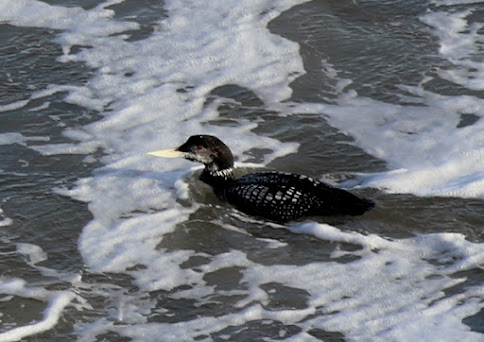
Sum/plumaged White-billed Diver - off South Landing © Nick Hull

As we retraced our steps back to the Obs car park we had a male Long-tailed Duck with fifty or so Common Scoter resting on the sea, possibly the same one we saw pass Hornsea a few days before. 

19th October - We went to Flamborough Obs ringing station to start the morning the wind had changed but it was going to increase as Storm Babet was on her way. There was some movement but most were birds that we assumed had some across the North Sea in previous days and were slowly making their way south and inland.  The only species added for the day was a Blackcap in the willows at the head later in the afternoon.  During the night the storm hit so we had a restful day on the 20th without any real birding and popped to Bempton to have lunch in the RSPB's cafe and picked up a gift or two for the grandchildren.  That evening we went to a talk by Simon Gillings from the BTO about how all the information gleaned from BirdTrack, eBird and Trektellen is used and how it helps them to understand population trends etc,  It was a most interesting talk. Which ended a very restful day.

Migrating flock of Lesser Redpoll © Nick Hull

21st October - We were up bright and early, maybe not that bright, but we were up and out to the Ringing station at the obs but then had a message to say that Keith Clarkson was doing vismig at the Bridlington Links so we headed there and joined him and just in time.  Standing along the entrance road to the Golf club gave a good surrounding view to the north, east and west.  Keith said we had just missed possibly upward of 1000 Starling moving south. We didn't have to wait long before a small group of Fieldfare then Redwing flew in over us.  This continued for some time with Redwing, Fieldfare and Song Thrush all in pretty good numbers passed over not in large flocks but a steady stream which kept us busy counting.  Then later in the morning we started to get Blackbirds, Redpoll and Goldfinch over.  We also had 7 Sparrowhawk go through towards the south along with Brambling, Chaffinch, Siskin, Meadow Pipit, Pied and Grey Wagtail, Skylark and a single Great White Egret, two Snipe plus several large skeins of Pink-footed Geese.  I think the oddest sighting of the morning was picked up by Jackie she called Hen Harrier going along the woodland opposite we all got onto the bird but we all realised it wasn't a Harrier but an immature Harris Hawk which had obviously escaped from somewhere. 

High flying Skein of Pink-footed Geese © Nick Hull

Flock of Fieldfare Brid Links © Nick Hull

After a visit to the supermarket and having lunch it was late afternoon before we headed to Bempton to see if we could find a Wood Warbler that had been found there but I have to say though we had very brief views Jackie or me haven't counted it.  But we had good views of two Short-eared Owls quartering the rough grass area by the old RAF buildings. We also had the usual Tree Sparrows and a pretty large Linnet flock and the common species expected at this location.  As we were leaving and drove up the hill out of the car park I noticed an owl to the left and pulled into a gateway to have a better view and we found two more Short-eared Owls quartering the area in fact I'm pretty sure I had a third which disappeared behind some scrub heading along the clifftop ending a very nice days birding.
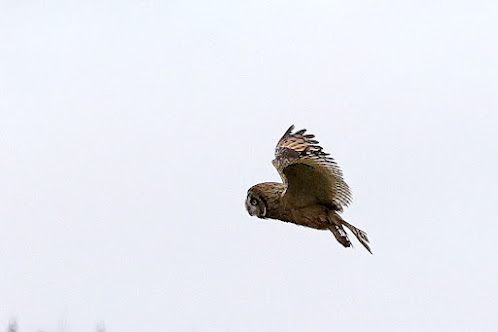
Another of the Bempton Short-eared Owl © Nick Hull

22nd October - Our last days birding and the last day of Migweek 2023.  We started at the ringing station and saw a good selection of birds in the hand ie Redwing, Song Thrush, Blackbird, Robin, Wren, Blue, Coal and Great Tit, Tree Sparrow and Lesser Redpoll. The best of the morning was one of Jackie's favourites a Woodcock.

Woodcock Flamborough Obs © Nick Hull

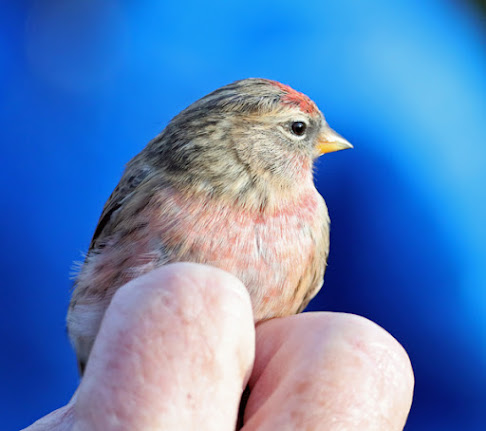
Male Lesser Redpoll Flamborough Obs © Nick Hull

After everything quietened down Jackie and I went of to investigate a small reserve called Filey Dams as we hadn't been there before.  We found the reserve at the far end of a housing estate, parked up and the first birds we saw were Tree Sparrow which seemed to be everywhere.  We went on to visit the three hides, there wasn't a great deal around but you could see it had potential.  After we went back to the campsite for lunch.  Just after finishing lunch news came our way that there were four Waxwing at a Bridlington Church so off we went to Brid.  After navigating round the houses we eventually found the church and joined a few other birder's on the pavement and one of them said they had been flushed by a Sparrowhawk and they were waiting for them to return then another said there is one in the centre of that tree.  With a bit of moving one way and another we managed to get in a position to see it amongst the branches.
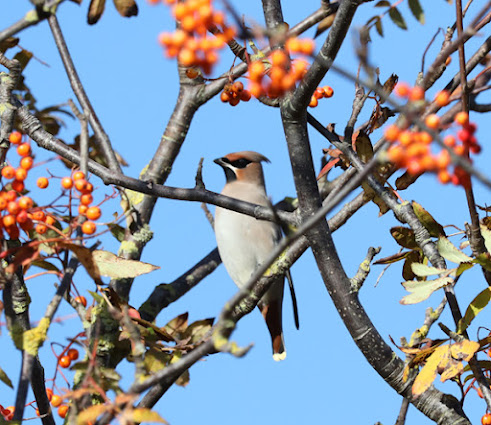
Waxwing _ Bridlington © Nick Hull

We were watching it move around in the tree for a while when it suddenly flew up calling excitedly and we were just wondering what caused it to do so when it was joined by three others and they all perched up in a row of cypress tree.

Spot the Waxwing shot © Nick Hull

I did manage to get one or two better shots before the flew off.

Waxwing - Bridlington © Nick Hull

What a way to finish a birding holiday with Waxwing for the year list.  In fact I'm going to make a little prediction I think if you live where there are berrying trees near your home keep an eye on them as I think it might be a good year for this species to turn up here in Dorset.

So the holiday brought us up to 202 species for the UK so far and we had 118 species on the holiday with a total so far 127 species for the October which I don'e think is to bad being we don't twitch as much now as we used to  trying to keep our carbon footprint down as much as is practical.

Sunday, 24 September 2023

Whale's Dolphin's and Pelagic Birds

On 13th September Jackie and I along with friends Margaret & Liz headed off to Plymouth for an overnight stay as next day we were joining the ORCA Whale and Dolphin Conservation on the Brittany Ferry mini cruise from Plymouth to Santander in Spain and meeting our friends Jackie & Kit with the idea for the trip  to see as many cetaceans as possible as we pass across the deep water areas and deep trenches of the Bay of Biscay.  Of course hoping for some good seabirds on our way.

We embarked around 12:30hrs once on board we put our bags into our cabin then went to a welcome talk by ORCA then we had a quick lunch and headed out on deck. We were still in view of land when we saw our first Cory's Shearwater and by the time we were approximately 30 miles from the coast we were seeing many Cory's and mixed in were the odd Gannet and Great Shearwater, it was some time before we saw our first Manx. I suppose it was about 2 hours after sailing that we saw our first cetaceans Common Dolphin which was the species we saw most throughout the trip.

Cory's Shearwater © Nick Hull

Common Dolphin © Nick Hull

Great Shearwater © Nick Hull

Towards the end of the the day we were over the Atlantic Shelf and one of the deep trenches of Biscay and we saw our first Whale species in fact we saw one then two Long-finned Pilot Whale surface. These are a small species of whale weighing in around 3 tons with a max length of around 6 - 7 metres.

Cory's Shearwater and Long-finned Pilot Whale - Bay of Biscay © Nick Hull

A good tip when out on a cetacean watch look out for the Shearwaters and Gannets etc particularly if they are circling an area as often there are whales or dolphin below the surface or about to surface as seen in the shot above a Cory's Shearwater escorting the Pilot Whale.

A while later we saw a blow it was like a column high into the air and lasted a few seconds before it dissipated off the port-side fairly distant, I raised the camera waiting for the next blow and hoped for a view, second blow came up no view then a third blow and a back and dorsal fin came into view and I shot off a few frames in the hope I'd get something.

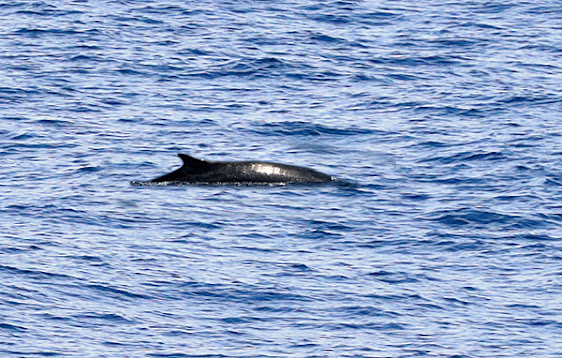
Fin Whale - Bay of Biscay © Nick Hull

As you can see above I managed a shot and with a bit of a crop 
a pretty respectable one at that.  This shot doesn't give the impression on the size of this species and indeed it may not be a full adult size animal.  Fin Whale are the second largest with a max length of around 26 metres and weighing in from anything from 40 to 80 tons they are an impressive whale.  A little later we had more blows and had at least three more individuals off the starboard-side of the ship.

Before it was time for dinner we managed to add Great and Arctic Skua and a Sooty Shearwater which were all around groups of feeding shearwater. Also Sunfish, Portuguese Man-of-War and quite a few Blue-fin Tuna were seen.

Next morning we were up early and out on deck before breakfast but it turned out to be very quiet just with a few shearwaters passing by.  As we were due to reach port in Santander in an hour or so we decided to go for breakfast.  By the time we had docked the weather was sunny and hot and Jackie and I decided to stay on board and watch the mountains and harbour for birds and just rest for the couple of hours before we sailed again on the reverse journey back to Plymouth.  We didn't expect to see too much in and around the Port and harbour but we added Cormorant, Yellow-legged Gull and the ubiquitous Feral Pigeon and Jackdaw. What was a little odd we had a flight of geese fly in from the sea direction which were possibly Canada Geese,  there was also a flight of Teal that flew in and headed inland. Scanning over the mountain tops that surround the port we managed and few distant Griffon Vulture moving across from one mountain to the next.

Mountains of the Cantabria Region that lay behind Santander Port

As passengers were coming back on board Jackie and I went off to lunch and we headed back up on deck prior to sailing meeting our friends again after their walk ashore and scanning the mountain-tops again managed to get a couple of Griffons for them to add to their trip lists just prior to sailing.  

Leaving Santander we had very little for possibly three hours just the odd Gannet and Shearwater. It was in the late afternoon before we had the first sighting of Common Dolphin and then shortly after a small pod of Risso's Dolphin surfaced near to the ship and then more Risso's then we had large groups of both Cory's and Great with a few Manx and a single Balearic Shearwater.  We had a small group of passerines pass going south which were possibly pipit species and we had a 'alba' Wagtail go over heading north.  It was now heading toward time for our evening meal and Jackie and friends went to freshen up for dinner and I had some extra time on deck with the ORCA team and a few other diehards.  Then came a call 'sighting' and looking in the direction the guy was pointing I saw a small whale breach clear of the water and as I went for my camera one of the ORCA team raised her camera and I had to step slightly left and I missed taking a shot of the second animal breaching. Fortunately Charlotte managed a respectable shot and shared it with me.  When analysed the photograph turned out to be a life tick for me and Charlotte a Northern Bottlenose Whale. They are the largest and scarcest of the beaked whales at around a max of 9 metres and between 6.5 - 7.5 tons and like other beaked whale species a squid hunter and found in the deeper parts of Biscay.  

Northern Bottlenose Whale breaching Bay of Biscay © Charlotte Kirchner

We had a few blows from several Fin Whale and then observation just started to slow down and Jackie is on deck telling me I had 20 minutes to be ready to go to dinner so ended another day.

Our last morning we were again up early and on deck and we were back into the Shearwaters, a Fulmar or two, one or two Manx and another Balearic Shearwater and a single Sooty and we started to see a number of gulls Herring Lesser-black and Great Black-backed Gull and as we approached the outer harbour of Plymouth Black-headed Gull and a Mediterranean Gull were seen

Great Shearwater © Nick Hull

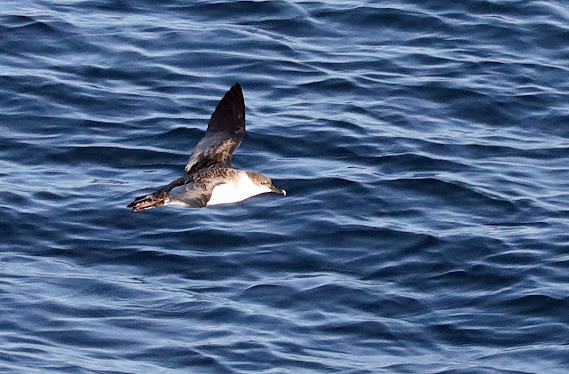
Cory's Shearwater © Nick Hull

It was good to spend a few days with friends and do some serious sea watching and be with a group of interested people looking for Cetaceans and helping them with their seabird identification skills. and learning a little more about the Cetaceans of Biscay from the ORCA guides.

Wednesday, 20 September 2023

Holiday Ends & Back Home.

After our few days resting and celebrating Jackie Birthday in Normandie where we had our first real rain of the holiday we didn't really add anything new but I did managed to get a shot of a Zitting Cisticola.  

Zitting Cisticola - Normandie © Nick Hull

Not such a bad bird to finish the holiday with.  We made our way back to Cherbourg and had a pretty uneventful crossing back to Poole.

We finished our holiday with 116 species of bird, 37 Butterfly and 9 Odonata.

The rest of June was spent catching up on things we needed to do around the garden and bungalow and for me getting back into the surveys on the Purbeck Heath National Nature Reserve (PHNNR) and Reptiles surveys at Arne.  I also lead a few of the RSPB Nightjar walks which I have to say very well attended and the Nightjar performed well.  With often a few plus species like Spoonbill, Woodlark,  Barn Owl and even a Hobby putting in an appearance on my walks.  We also went back to doing Osprey watch with Birds of Poole Harbour with the three young doing well after hatching whilst we were away.

We had visits to Badbury Rings, Wareham Forest, Longham Lakes and Holton Lee the latter was a Heathland bird survey. We didn't record anything outstanding and only managed 64 species before the end of the month.

July followed in much the same vein with surveys for me and then local birding with Jackie.  Though on the 7th July Jackie and I headed off to Wales to visit Jackie's Aunt and had a long days birding Anglesea catching up with Black Guillemot, Chough and Puffin at South Stack.  We also visited Cemlyn Bay to check out the tern colony there, though they had been effected by bird flu it had appeared to have passed and there were still good numbers of Arctic, Common and Sandwich Tern breeding also a pair of Avocet which was the first Welsh breeding record with three youngsters. 

Arctic and Common Terns - Cemlyn Bay Wales © Nick Hull
--------------------------------------------------------------------------------------------------------------------------

Back in Dorset again we didn't get out to do much birding, but I was still getting out doing survey work on the PHNNR doing Pond Surveys, which include checking for counting Dragon and Damselflies, Raft Spider, Pond Hopper, and one or two pond plant species.  Also counting numbers of Purbeck Mason Wasp, Heath Tiger Beetle and Heath Potter Wasp and any of the native reptiles and anything else that looks interesting which may not necessarily be scarce or rare but not recorded before or often.   A few shots of the species mentioned though they have been represented here before but it will save you time looking them up.

Purbeck Mason Wasp Pseudepipona herrichii collecting water at a pond © Nick Hull

Heath Potter Wasp Eumenes coarctatus flying off with clay/mud to make her
nesting pot © Nick Hull

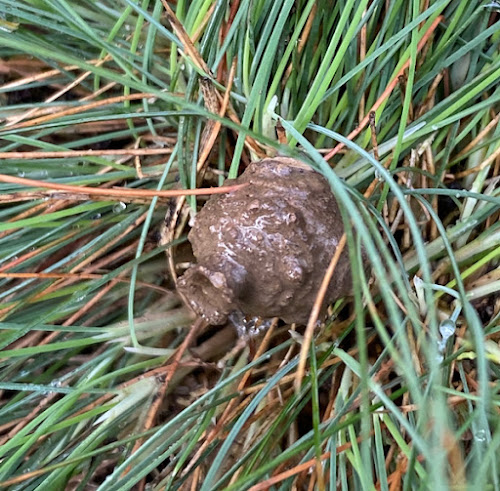
Freshly completed Heath Potter Wasp Eumenes coarctatus pot © Nick Hull

Heath Tiger Beetle are a ferocious predator as a larvae and as well as an adult. The larvae sit in its burrow and ambushes anything that passes by, drags it in and eats it.

Heath Tiger Beetle Cicindela sylvatica at the entrance to its burrow
awaiting prey © Nick Hull

The adult beetle is a bit like a cheetah they run really fast to catch prey. They can also fly very well but doesn't fly very far usually landing a metre or so away when disturbed.

Adult male Heath Tiger Beetle Cicindela sylvatica © Nick Hull

For one of Britains largest spiders Raft Spiders can be fast across the water when they need to be and is one of the top pond predators. 

Raft Spider Dolomedes fimbriatus waiting for prey on a small pond © Nick Hull

Here are a couple of the flowers that we also look for and count when we find them.  Yellow Centaury loves to grow in disturbed ground and has often grown up in vehicle tracks.

The diminutive Yellow Centaury Cicendia filiformis © Nick Hull

lesser Butterfly Orchid is a scarce rare orchid and they like to grown in wet marshes which are drying out or that's what it seems to like here in the PHNNR. However they are subject to being eaten at times by deer and perhaps by the cattle so it's important that we monitor these beautiful flowers to make sure the impact by the cattle isn't having an adverse effect.

Lesser Butterfly Orchid Platanthera bifolia © Nick Hull

Sothern Damselfly are a very particular species in that it is often found on heathland but where water has passed through or from chalk downland which does restrict them from spreading further from there breeding site. Plus they are not the strongest of flyers.  It is said that they also like grazed areas so it is hoped they may benefit from the open cattle grazing in the future.

Possibly one of the rarest of UK s Odonata
Southern Damselfly Coenagrion mercuriale © Nick Hull

There is also two bee-fly species that we record which are found on the heathlands, as they are parasitic one on mining bees and the other on a scarce species of Ammophila Wasp. They are the Heath Bee-fly and the Mottled Bee-fly.

Heath-Bee-fly Bombylius minor © Nick Hull

Mottled Bee-Fly Thyridanthrax  fenestratus © Nick Hull

We also helped out on a couple of bird boats with Birds of Poole Harbour on the Osprey boats which cruise the Wareham channel where we saw 7 different Osprey and two White-tailed Eagle which have been residing in the Wareham Channel area for over a year now though they do go off on a jolly on occasions elsewhere.  

CJ7 with fish off back to the nest site © Nick Hull

On one of the boats we had time and good weather to cruise up the Wytch Channel along Shipstal Beach and view the small gull and tern roost and was able to catch up with the presumed returning Forster's Tern in the roost.

Distant shot of the Forster's Tern on the marsh roost at Shipstal Beach © Nick Hull

Forster's Tern - Arne Shipstal Beach © Nick Hull
We also made a visit to Lodmoor during August and had a pretty good day and I managed a couple shot of one of the Great White Egret as it few in and pitched up not that far away from us.

Great White Egret - Lodmoor © Nick Hull

From the birding perspective by the end of the month we had recorded 84 species from very few locations our year list stands at just 183 and we still have some birds that we haven't connected with which are relatively common so hopefully August will see us picking up a few migrants and catching up on a few we have missed.

Monday, 28 August 2023

Tour de France Part 2 The Dordogne

We were up fairly early, breakfasted, packed the van and headed off across the Gironde vineyards towards the Auberge de Castel Merle at Serseac in the Dordogne. This would be a new department for us so we didn't really know what to expect other than what friends have told us, that it was a beautiful area to visit. We travelled from what you could describe as flat arid dry marsh landscape to a lush green forested, deep river valleys with picturesque villages many with a medieval looking architecture.  

After we arrived in the Dordogne we had a little time before we could check-in to our hotel so we had a little explore locally and parked in a lay-by at the edge of a forest and found a number of species of butterfly and a Wall Lizard.  We also came across a single Pyramidal Orchid on the road verge.

Pearly Heath & Large Skipper © Nick Hull

Female Wall Lizard  © Nick Hull

Pyrimidal Orchid © Nick Hull

Our hotel was 300 years old and started as a farm house and later developed into a hotel and was still owned by the same family and they believe there had been a building there since Roman times.  It was situated on a promontory high above the Vézère River. 

This is the view of the hotel on are arrival.

Hotel de Castel Merle, Sereac Dordogne

We were allocated the Garden room which is through the door on the right of this photograph.

View of our room there is an entrance hall to the right out of view.

This is the view from the door of our room looking across the large patio area with the two pavilions where we had breakfast in the mornings

View from the door of our room

This is the view looking down over the river Vézère from the patio promontory below.

Looking down from the hotel patio over the Vézère River 

I'm not sure how high up we were but possibly 200m above the river but the steep rocky cliffs provided a nesting site for a pair of Peregrine whose young had just fledged and they were often screaming and chasing around very close and sometimes landing in the trees that were on the patio.  There were several pairs of Golden Oriole and one morning while recording the dawn chorus I ended up recording a territorial dispute between two pairs right over the patio area.  The screeching cat like calls would of woken the dead, though Jackie slept through it even when I tried to wake her.  In fact more or less everywhere we went near the river we recorded Golden Oriole though I never managed to get a shot of one they always seemed to hide behind leaves or a branch.

One morning whilst I was waiting for Jackie to join me for breakfast a Red Squirrel ran along the fence to get food from the bird feeder as they do.

Phone shot of Red Squirrel going to the feeder.

It was now our eleventh day in France and the plan was to visit a few sites along the valley starting just a mile or so up the road where there was a view point to look across the valley and a woodland trail good for butterflies. In fact it turned out to be very close to the lay-by we stopped at the day before.

View Point

From the view point we had a grand view over the valley and saw several Black Kite and listened to them calling.  Though it is also a place to see eagles none were seen by us whilst we were there.  So we moved across the road onto the woodland trail and didn't walk far when it opened up into a small meadow.  It was a nice warm sheltered spot and butterflies everywhere. We found Adonis Blue, Pearly Heath, Marbled White, Peacock, Red Admirals and Meadow Brown.  Though for us the ones that took our attention was Black-veined White, Heath Fritillary and Woodland Grayling mainly as they are species we don't get at home.

Heath Fratillary © Nick Hull

Woodland Grayling © Nick Hull

A slightly worn Black-veined White

We then moved on to a old stone quarry again for butterflies also for a chance of finding Ocellated Lizard which we failed to find.  Though we did add a few butterflies to our trip list with Essex and Small Skipper, Adonis Blue, Spotted and Heath Fritillary then for us here the more interesting were Great Banded Grayling, Southern White Admiral and Wood White.  We also added a bee-fly species I haven't seen before and a damselfly to the small Odonata we had seen.

The Great Banded Graylings were very flighty and wouldn't settle close for a really good shot so I had to shoot at distance so couldn't get any real definition and detail but you can see what they are.

two shots of Great Banded Graying © Nick Hull

There were plenty of Wood White and again because the was so hot to get one settled for any time to get a shot was next to impossible but managed to get few ok shots 

Wood White © Nick Hull

Whilst searching around the quarry slightly hidden behind a large bolder Jackie found this super Red Helleborine a plant we have only seen once before many years ago.

Red Helleborine © Nick Hull

The last butterfly we found here was this slightly worn Southern White Admiral when they are fresh the colours are stunning but unfortunately this one was a little faded but none-the-less it was another species to add to our holiday list for the Dordogne. 

Southern White Admiral © Nick Hull

Alway interested in the Odonata and came across these damselfly, which our guide gave as Blue Featherleg which I thought was a new species, but it wasn't until we were home that checking the scientific name that I realised it was a name change for White-legged Damselfly.  None the less it was new for us in France.

Blue Featherleg (White-legged Damselfly) © Nick Hull

Another species which was nice to find here in the quarry was Dune Villa a Bee-fly a pretty scarce species in the UK and the second time I've recorded one in France. 

Dune Villa © Nick Hull
We spent some time here trying to see the lizard but eventually we decided to move on to our next planned location.  This was right on top of the hills with an amazing almost 360º view and again the guide book said a chance of eagles. Here the scubby causse hillside habitat was provided us with some nice views of a number of butterflies many we had already seen but one or two new ones.  

Like this Cleopatra a stunning butterfly which was visiting the Vipers Bluegloss and allowed me to play with the camera settings to get a few acceptable shots.

Underside and upperside of Cleopatra butterfly © Nick Hull

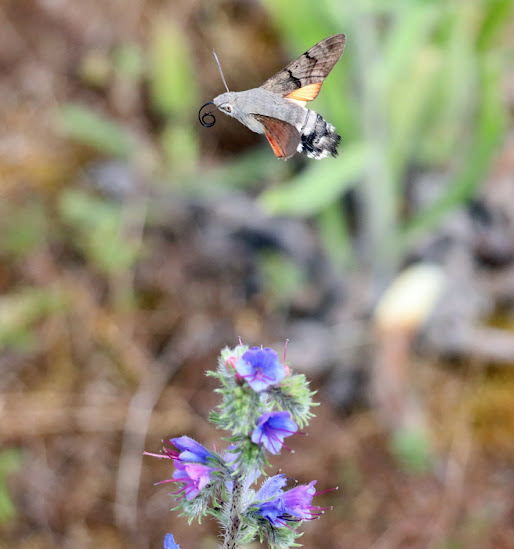
I also managed a few more shots of various Hummingbird Hawk-moths as they zoomed around the Vipers Bluegloss.

Humminbird Hawk-moth manoeuvring  to come in the Vipers Bluegloss © Nick Hull

We decided we had seen most of what was on offer at this site and it was approaching lunch time so we  headed off to lunch. Which turned out to be a bit of an odd experience but that's another story.  As we were getting into the van I picked up movement on the bramble and it turned out to be this Blue-spot Hairstreak.

Blue-spot Hairstreak © Nick Hull

On the 13th we drove along the valley to Limeuil a very picturesque village next to the river where the Vézère River which starts under the ridge to the left and the Dordogne River continues under the bridge on the right.

The twin bridges / viaduct over the Vézère & Dordogne Rivers © Jackie Hull

There was a good House Martin colony under the parapit of the bridge and there were several Swallow also nesting nearby as they were coming into pick up mud from the bank to build their nests.


House Martin coming in to the bank for mud for nest building

Swallow doing the same with one coming and one leaving with mud.

We walked back to the van to cross over the two bridges to continue our planned route, as we neared the van we had close views of a Black Kite that circled over us before drifting off down river.

Black Kite © Nick Hull

Once we had crossed the bridges we stopped on the opposite bank for a brief stop at a slipway for boats to enter the river where we had a few odonata along the river bank.

When I first saw this pair of Western Demoiselle I thought they were Banded it wasn't until I was checking through my photographs I noticed the dark pigmented area extends to the tip of the wing and looking it up in a reference found they were a new species for us in fact possibly one we have overlooked in the past.
Western Demoiselle - male & Female © Nick Hull

This pair below we have seen in the back in Dorset but with the name change in the reference we didn't realise until later but they were very nice to see.
Female & Male Blue Featherleg (White-legged Damselfly) © Nick Hull

This following species I thought was a bright female of the previous species until I noticed the blue eyes so took a few shots of it, which I'm glad I did, as it was another new species for us

Orange Featherleg Platycnemis acutipennis  Nick Hull

Whilst there we also had Azure Bluet once called Azure Damselfly, Black-tailed Skimmer and a new beetle species Blue-violet Chafer an absolute stunning beetle.

Blue-violet Chafer Hoplia coerulea 

Our next stop was just a couple of miles further up the road, we passed through a small wood and exited out into farmland.  As I was looking for a safe place to park up Jackie said whats that hovering over there and I pulled over and took a look, it was a Black-shouldered Kite.  Then I heard a Crested Lark and had a brief view as in pitched in to the grass field to our left.  We walked up the road slowly keeping an eye on the area where it pitched in and it flew up from a totally different place or perhaps another bird  By the time we decided to move on we had see at least three Crested Lark, lots of Corn Bunting, Skylark and a Black Kite.

It's strange when we are in France we take time to have lunch out and theneat light with a glass of wine in the evening.  So we headed into Campagne for lunch and after went to the Chateaux where in our guide book mentioned orchids and Common Redstart was easy to find there.

The Chateaux and lake at Campagne

As we walked into the ground of the Chateaux there was a lake and a small river that fed the lake and lots of odonata Azure Bluet, Blue-tailed Damselfly, Scarce Chaser, Emperor Dragonfly

Common Bluetail (Blue-tailed damselfly) Ischnura elegans © Nick Hull

Blue Chaser (Scarce Chaser) Libellula fulva  © Nick Hull

As we walked around the lake we approached some mature Beech trees and we both heard the song of Common Redstart and it very nicely appeared for us and landed ready to be photographed, what a stunner.

Common Redstart (male) © Nick Hull

Also under the trees here we found more Red Helleborine a fairly scarce plant in the UK and here we've have found them in two different locations in a couple of days.

Red Helleborine © Jackie Hull

Further around the lake I photographed a pair of damselflies in cop, the male having very blue eyes and checking later they were indeed Blue-eye's, which used to be named Goblet-marked Damselfly, another new species for us.

Blue-Eye (Goblet-marked Damselfly) Erythromma lindenii © Nick Hull 

As we were leaving I had a quick shot of this Paper Wasp Polistes dominula a species that is rare in Britain I think only known in a area of Richmond in Surrey.

Paper Wasp Polistes dominula © Nick Hull

As we got back in the car park I spotted a large fritillary fly by in front of the van and land on a buddleia and it turned out it was a Silver-washed Fritillary and new for the holiday.

Silver-washed Fritillary © Nick Hull

This brought another day to an end and it was back to the Castel Merle for our last night in the Dordogne and start our journey home with another brief visit to the Loire before continuing to Normandie for our last few nights before catching the ferry home.